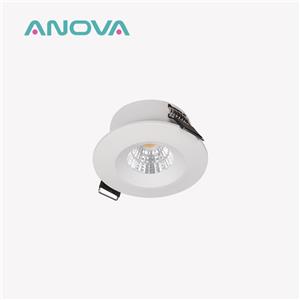
How to Specify Commercial LED Downlights for ODM Manufacturing
Designing a commercial LED downlight portfolio for global markets requires balancing optical performance, driver reliability, and thermal limits before cutting steel for tooling. This guide provides lighting brands and OEM/ODM buyers with the essential technical parameters to lock into their product design brief.
1. Photometric Parameters
These define what the light actually does — the core of any commercial LED downlight specification.
Parameter | Typical Commercial Range | Notes |
Lumen Output | 600 – 3,000 lm | Match to ceiling height and application |
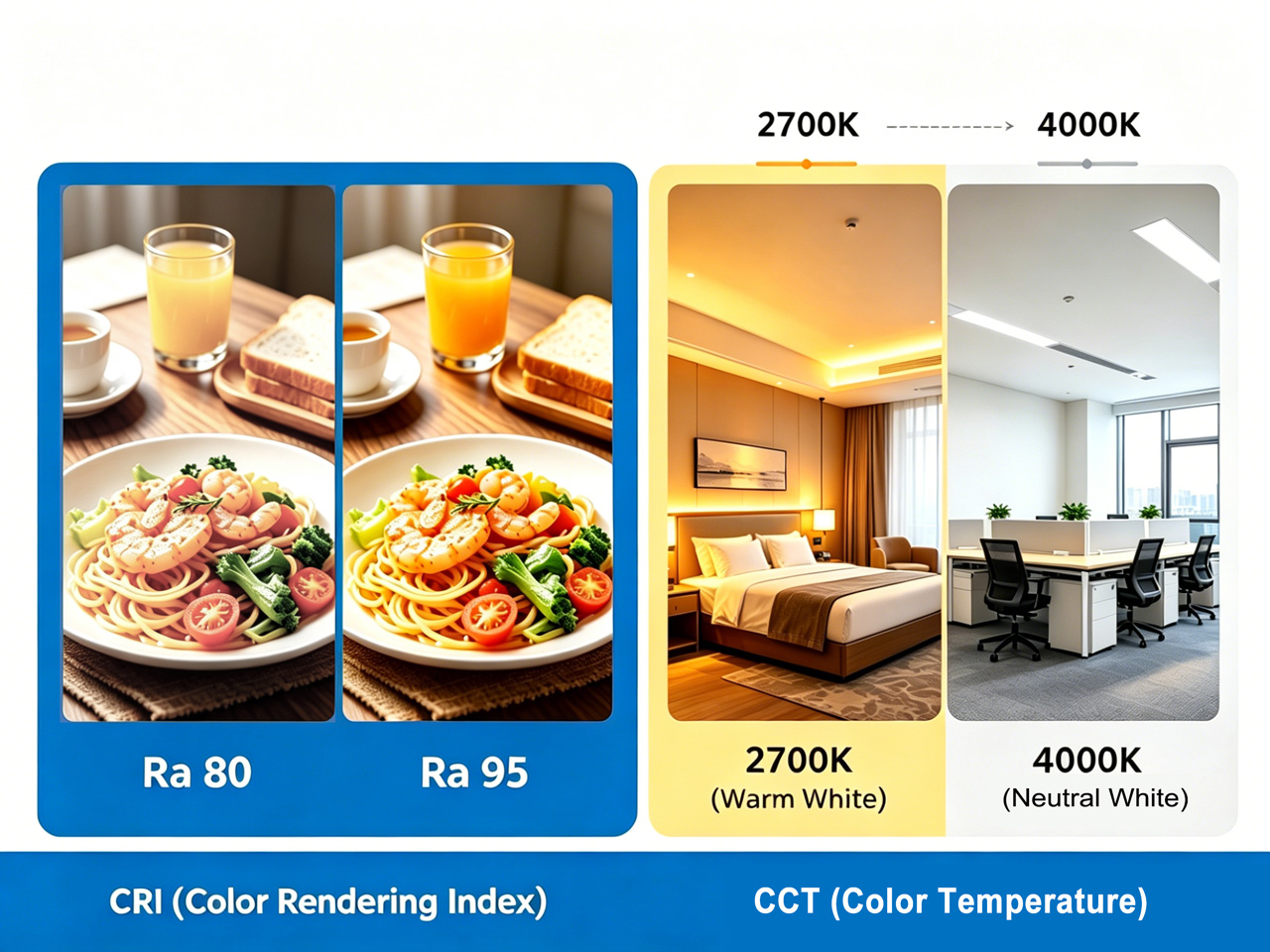
CCT | 2700K – 6500K | Hospitality: 2700–3000K; Office/retail: 3000–4000K |
CRI (Ra) | ≥80 standard; ≥90 premium; ≥95 museum-grade | Higher CRI means higher LED cost |
R9 Value | >50 for general; >80 for fashion/retail | Critical for red-tone accuracy |
Beam Angle | 15° – 60° (fixed or adjustable) | Specify if optic needs to be interchangeable |
UGR | ≤19 for office/task; ≤22 general commercial | Lock reflector geometry and luminance cap into the brief before tooling |
SDCM / MacAdam | ≤3-step premium; ≤5-step standard | Tighter binning increases LED sort cost — define per SKU tier |
Specifier tip: If your end-customer sells into fashion retail or food service, mandate CRI ≥90 and R9 >80 from the start. Retrofitting this after tooling is expensive. For office or healthcare projects, a UGR ≤19 requirement must be locked into the optical design at briefing stage — not added as an afterthought. SDCM tolerance should be agreed per SKU, as premium binning carries a cost premium that needs to be priced into your programme from the outset.
2. Driver Architecture
The driver is the most failure-prone component in an LED luminaire. Specifying it precisely at the ODM stage avoids costly field returns.
Key decisions:
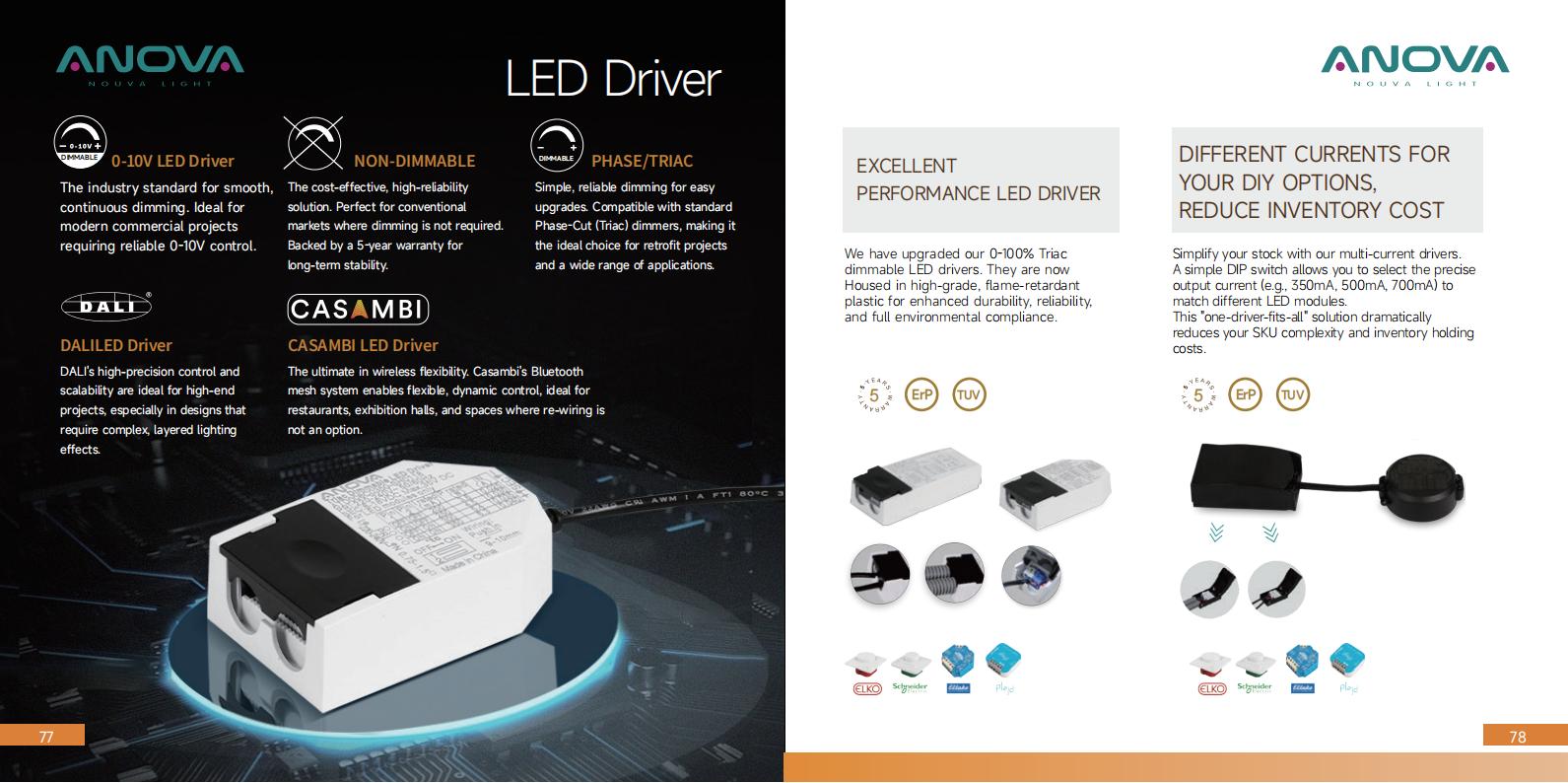
● Constant current vs constant voltage — downlights almost always use constant current; confirm your target LED module's forward current (typically 350 mA, 500 mA, 700 mA, or 1050 mA)
● Dimming protocol — TRIAC (phase-cut), 0–10V, DALI-2, or Bluetooth/Zigbee mesh. DALI-2 is now the default for European commercial projects; confirm with your target market
● Flicker / Pst LM — specify Pst LM <1.0 (per IEEE 1789 / IEC TR 61547-1) for office, healthcare, and education applications; EU public-sector tenders increasingly mandate this explicitly and it must be driven by the driver design, not added post-certification
● Power factor — specify ≥0.9 for any commercial application drawing >25W
● THD — total harmonic distortion ≤15% is standard; ≤10% for sensitive grid environments
● Driver location — integral (compact housing) vs remote (ceiling plenum). Remote drivers allow slimmer fixtures and easier maintenance
An ODM partner with in-house driver development can tune flicker, THD, and dimming compatibility to your exact housing geometry — an advantage over sourcing the driver separately from a third party.
3. Thermal Management and Lumen Maintenance
Heat is the primary driver of LED lumen depreciation. Defining the thermal path at specification stage determines long-term reliability, warranty risk, and projected L70 life.
Heat path elements to specify with your ODM:
1. LED junction → MCPCB — thermal interface material (TIM) specification: paste vs pad, and minimum thermal conductivity requirement
2. MCPCB → heatsink — contact area, fin geometry, material (cast aluminium preferred for compact downlight housings)
3. Heatsink → ambient — convection surface area; sealed vs vented housing trade-offs for IP-rated designs at elevated Tq
L70 / TM-21 projection:
Specify minimum L70 life at rated drive current and ambient temperature (Tq). For European commercial programmes, L70 ≥ 50,000 hours at Tq 25°C is a common baseline; premium specifications target L70 ≥ 75,000 hours. Request TM-21 projection data from your ODM referenced against LM-80 test reports on the specific LED package used at your specified drive current — not generic LED family data.
Ceiling plenum temperatures in commercial buildings frequently exceed 35°C during summer months, meaning that L70 projections based on Tq 25°C bench data can significantly overestimate real-world lamp life. When the actual plenum operating temperature is higher, lumen depreciation accelerates, and warranty projections based on standard test conditions no longer reflect field performance. Specify L70 life using test conditions that match the anticipated plenum temperature for your installation — not just ambient room temperature. If plenum Tq data is unavailable, request the ODM run TM-21 projections at Tq 35°C or 45°C as a conservative bound for warranty documentation.
Application | L70 Target | Tq Test Condition |
Standard commercial | ≥ 50,000 h | 25°C |
High-bay / industrial | ≥ 50,000 h | 45°C |
High-humidity or weather-exposed commercial | ≥ 50,000 h | 55°C |
4. Ingress Protection and Housing Rating
Commercial downlights span environments from dry office ceilings to outdoor-exposed canopies and weather-facing facades. Getting the IP rating wrong is a compliance failure, not just a quality issue.
Environment | Minimum IP | Additional Requirement |
Dry indoor ceiling | IP20 | Standard |
Bathroom / wash area | IP44 | IK rating if accessible |
Commercial kitchen | IP65 | Stainless or coated trim |
Covered outdoor soffit | IP54 | UV-stable housing material |
High-humidity or weather-exposed commercial | IP65–IP66 | Corrosion-resistant finish; accelerated humidity cycling test |
For demanding environments such as high-humidity commercial buildings or weather-exposed facades, request accelerated humidity cycling test data (IEC 60068-2-78 or equivalent) on the hardware and finish from your ODM.
5. Mechanical and Form Factor
● Cut-out diameter / tile module size — must match your retrofit target or new-build ceiling grid
● Housing depth — plenum clearance is often a hard constraint in commercial refits
● Trim style — fixed, adjustable gimbal, anti-glare baffle, or flush frameless
● Module interchangeability — can the LED engine be replaced without removing the housing? Modular designs significantly extend product lifecycle and reduce warranty costs—typically reducing per-fixture lifetime cost by 30–40% vs fixed integrated designs.
6. Compliance and Certifications
Different markets require different marks. Define your target markets in the brief:
Market | Required Mark |
European Union | CE, LVD, EMC; DALI-2 if applicable |
Germany (premium) | TÜV or VDE driver testing often expected |
Australia / NZ | SAA (C-Tick / RCM) |
USA / Canada | UL or ETL, Energy Star (if applicable) |
Special regulated applications | MED 2014/90/EU, DNV |
An ODM that manages certification across these jurisdictions as part of the programme — rather than leaving the buyer to arrange third-party testing — dramatically reduces time to market.
7. Warranty Validation
A product warranty is only enforceable if the underlying failure modes are understood and tested. Before signing off an ODM programme, confirm:
● LM-80 data on the specific LED package at the operating current you have specified — not a higher-current binning test from a related family
● TM-21 projection calculated from that LM-80 data at your specified Tq and drive current
● Driver MTBF at the rated case temperature, referenced to a recognised standard (e.g. MIL-HDBK-217)
● Field return rate KPI written into the ODM supply agreement, with root-cause reporting obligations on the manufacturer
● Warranty-coverage scope — does the ODM's warranty cover the complete luminaire, or only the LED module? Confirm in writing before production sign-off
8. Packaging and Logistics Specification
Often missed in the technical brief:
● Carton drop-test rating (ISTA 2A or equivalent)
● Neutral vs. branded packaging (ODM vs. private label)
● Master carton count and pallet configuration
● Labelling language requirements (CE marking text, RCM mark placement)
Specification Checklist
Before sending a brief to your ODM manufacturer, confirm you have defined:
● [ ] Lumen output, CCT, CRI (and R9 if relevant)
● [ ] UGR maximum and reflector / optical geometry requirement
● [ ] SDCM / MacAdam step tolerance per SKU tier
● [ ] Beam angle and optic interchangeability
● [ ] Driver type, dimming protocol, power factor, THD
● [ ] Flicker / Pst LM limit (office, healthcare, education)
● [ ] Thermal path: TIM spec, heatsink material, fin geometry, sealed vs vented housing
● [ ] L70 target and Tq test condition; TM-21 data sourced from LM-80 on the specified LED package at specified drive current
● [ ] IP rating and finish treatment for the target environment
● [ ] Housing form factor (cut-out, depth, trim style)
● [ ] Modular vs integrated LED engine strategy
● [ ] Certification marks required by target market
● [ ] Warranty validation: LM-80, TM-21 projection, driver MTBF, field return KPI, coverage scope in writing
● [ ] Packaging spec and logistics terms
Frequently Asked Questions
Q: What is the cost difference between 3-step and 5-step MacAdam binning?
3-step MacAdam binning typically adds 8–15% to the LED BOM cost vs 5-step. Reserve the 3-step for premium hospitality and retail SKUs where colour consistency is visible; use the 5-step for general commercial applications.
Q: How do I verify an ODM factory's tests to LM-80 standards?
Request the LM-80 test report from an ISO 17025-accredited lab (not in-house). Cross-reference the LED package part number and drive current against your specification. The report must cover at least 6,000 hours of testing at three case temperatures.
Q: When should I choose a remote driver over an integral driver?
Choose remote drivers when plenum depth is tight (under 100mm), when servicing access is restricted, or when the fixture must achieve a very slim profile. Integral drivers are preferred for simple single-fixture retrofits where housing space permits.
Appendix: Practical Application of Downlight Engineering Standards
(Note: The following section illustrates how the global downlight specification standards outlined above are physically executed by international OEM/ODM manufacturing frameworks, using ANOVA Lighting as a benchmark.)
As an established ODM partner with over 20 years of commercial project experience, ANOVA Lighting transforms these rigid technical specifications into highly scalable architectural systems. Our product architecture addresses the critical parameters of commercial LED downlight design through two dedicated capabilities:
A. Advanced Mechanical Execution: The Modular Framework
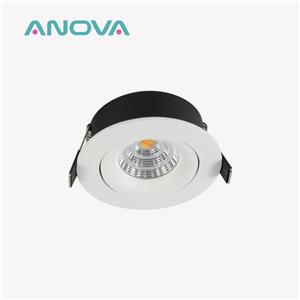
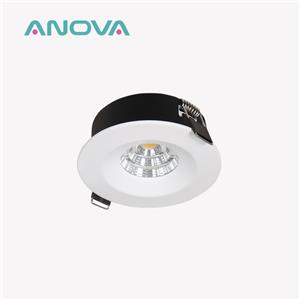
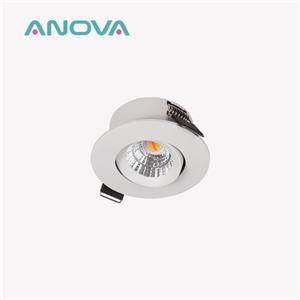
ANOVA's Modular Downlight System divides the luminaire into self-contained LED core modules and independent trim profiles. A single certified engine pairs with a range of rings, frames, and bezels across multiple SKUs. Front-Fixed mechanisms allow contractors to perform optical adjustments, beam angle modifications, or maintenance upgrades directly from the room side, without disturbing the ceiling plenum.
B. Advanced Optical Control: Precision Glare and Beam Shaping
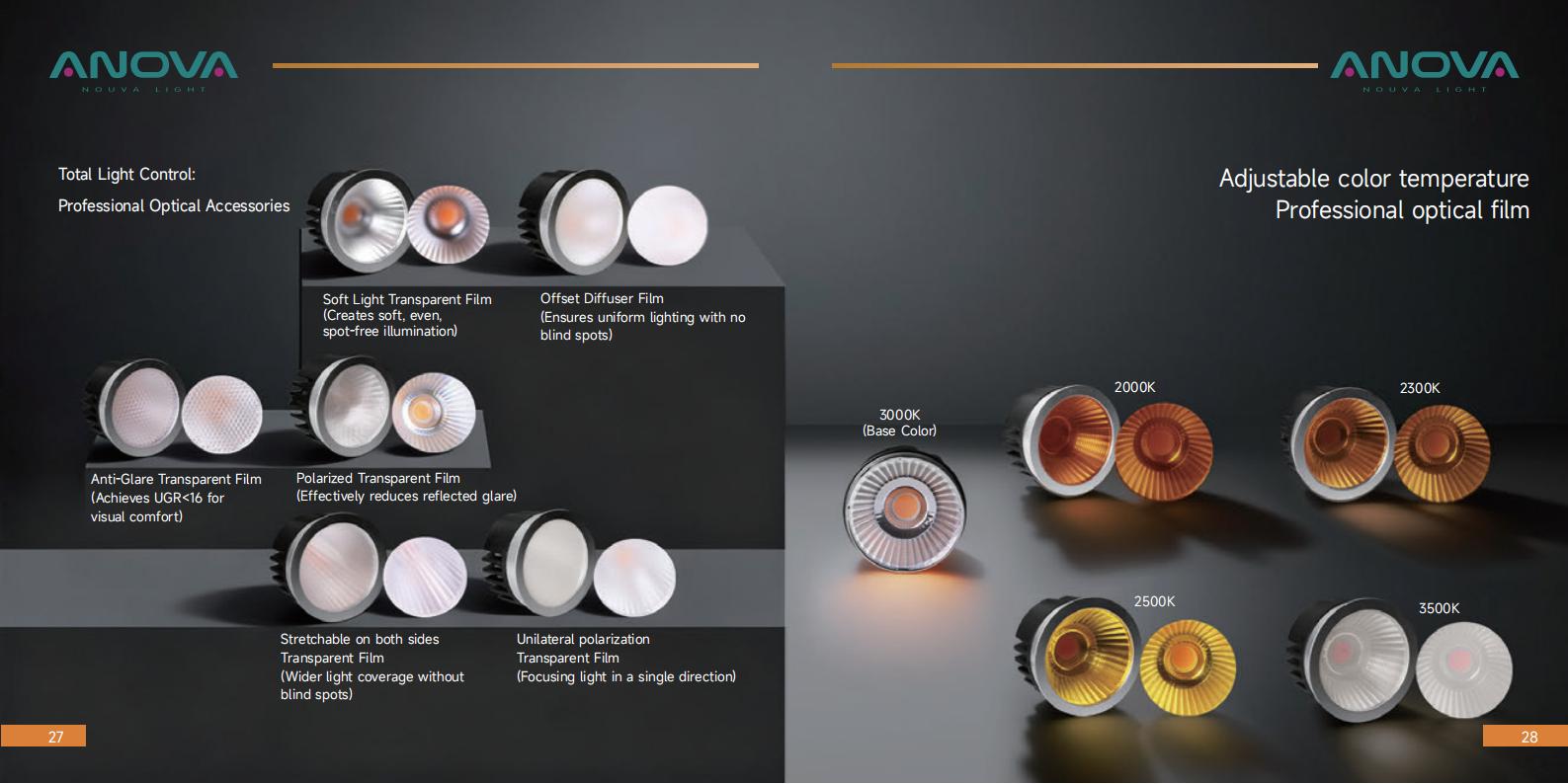
ANOVA integrates Professional Optical Film technology to meet UGR ≤19 requirements while extending beam-shaping flexibility beyond traditional plastic reflectors. The optical stack supports three film types:
● Anti-Glare Filters: Layered to reduce glare indexes to UGR <16 for demanding workplace environments.
● Soft Light & Diffuser Films: Eliminate hot-spots and smooth out luminance across wide surface grids.
● Directional Shaping Films: Unilateral and bilateral polarization technologies allow a standard downlight core to deliver asymmetrical wall-washing and directional accentuation without additional tooling.
Through this unified development channel—combining in-house tool construction, thermal simulation, goniophotometer verification, and international certification management—ANOVA operates as a seamless extension of your product development team, delivering certified downlight portfolios in 8–12 weeks from specification sign-off.
Ready to lock in your next commercial LED downlight portfolio? Contact ANOVA's Engineering Team to request downlight core samples for testing or get a tailored ODM manufacturing solution.
Related Resources
● LED Driver Selection for Commercial Projects