
2026 China LED ODM Manufacturer Checklist
Why Supplier Evaluation Matters More in Lighting Than in Most Categories
LED lighting sits at the intersection of electrical safety, photometric performance, and thermal engineering. A poorly qualified supplier creates risk on three axes simultaneously:
● Safety recalls — driver failure or inadequate IP protection can cause product recalls in regulated markets (EU, AU/NZ, North America)
● Performance failure — lumen depreciation faster than the L70/B50 specification, colour shift outside MacAdam ellipse tolerances
● Supply chain disruption — a factory with shallow supply chain management fails during chip shortages or component lead-time spikes
The 8-Point Checklist
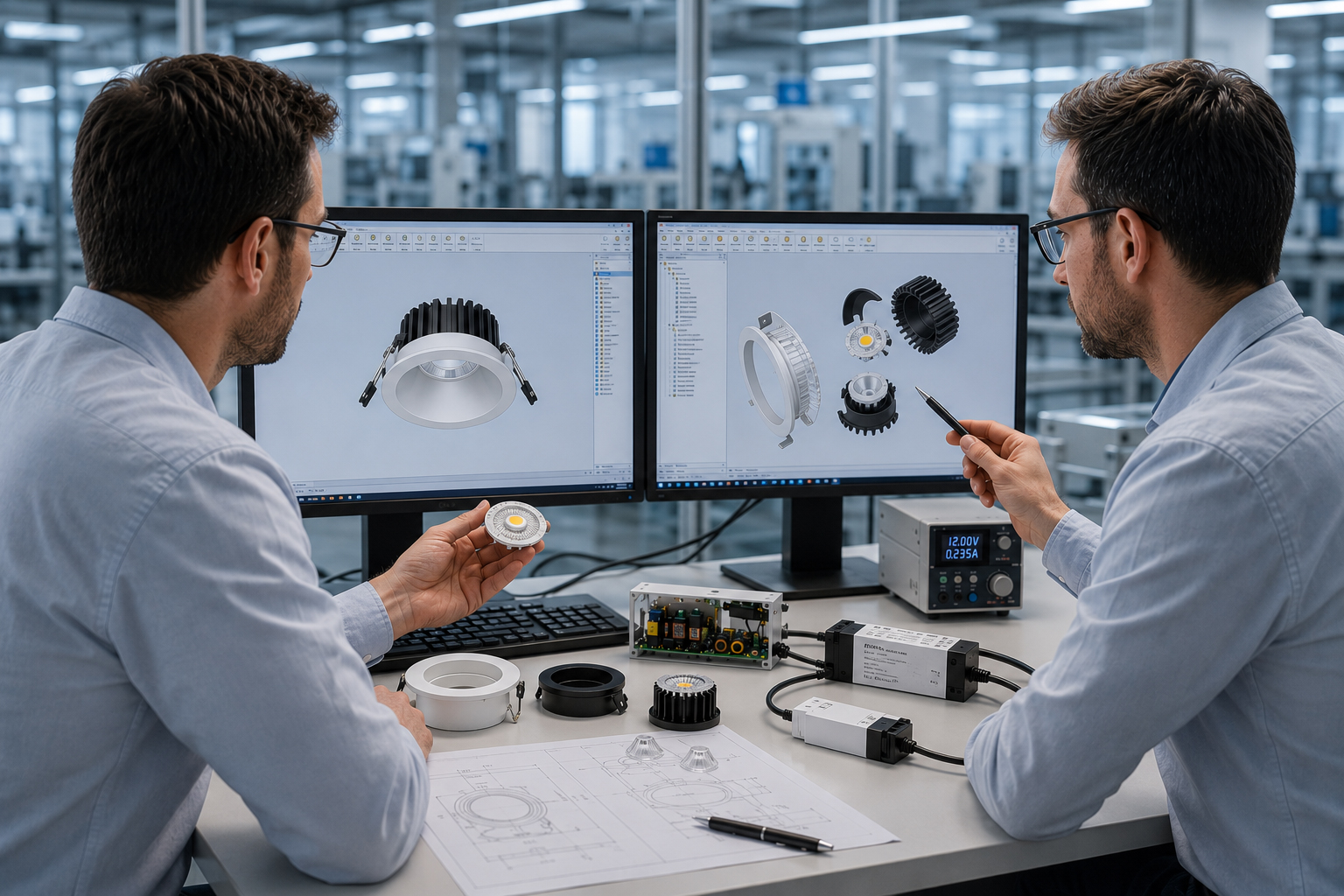
1. In-House Design Capability
What to ask: Does the factory have in-house optical engineers and mechanical designers, or do they source everything from external catalogues?
What good looks like: An engineering team that can develop custom optics, specify heat dissipation for your lumen target and thermal environment, and modify housing geometry to match your retrofit or new-build constraints.
Red flag: "We can modify the existing model" — when the modification requested is fundamental to the brief. This indicates catalogue-based assembly, not genuine ODM capability.
2. Custom Driver Development
What to ask: Can you develop a driver to my dimming protocol specification, or do you select from a third-party driver catalogue?
What good looks like: In-house driver engineering with the ability to specify DALI-2, 0–10V, TRIAC, or proprietary wireless dimming protocol; power factor and THD targets set to your requirement, not the factory's standard catalogue.
Why it matters: A driver sourced from a catalogue may not be tuned for your specific LED module's forward voltage range, leading to flicker, compatibility failures, or early driver failure.
What to verify: Ask for a sample driver specification sheet with the factory's name on the document — not a third-party datasheet.
3. Quality Systems and Laboratory Capability
What to ask: Are you ISO 9001:2015 certified? Walk me through your IQC, IPQC, and OQC process for a new ODM product.
A credible manufacturer operates quality control across three stages — not just at final inspection:
Stage | What it covers |
IQC (Incoming Quality Control) | Inspection of raw materials and sub-assemblies on arrival: LED bins, driver components, die castings, optical parts |
IPQC (In-Process Quality Control) | Checkpoint inspections during PCB assembly, soldering, optical alignment, and wiring — defects caught before they propagate |
OQC (Outgoing Quality Control) | Final product inspection against AQL sampling plan before shipment; photometric, electrical safety, and visual criteria |
ISO 9001:2015 as a baseline: ISO 9001:2015 certification is a minimum indicator of documented quality management. Ask to see the current certificate and the scope of certification — it should cover product development and manufacturing, not just sales.
[Download our ISO 9001:2015 certificate]
AQL sampling (per ISO 2859-1): Ask which AQL level is applied at outgoing inspection. AQL 1.0 or tighter for critical defects (electrical safety, IP failure, lumen output deviation) is the appropriate standard for regulated-market commercial lighting.
Traceability: Confirm that production records link each shipped unit or batch to its LED bin, driver lot, and PCB assembly date. Traceability is not optional for recall management in EU and AU/NZ markets.
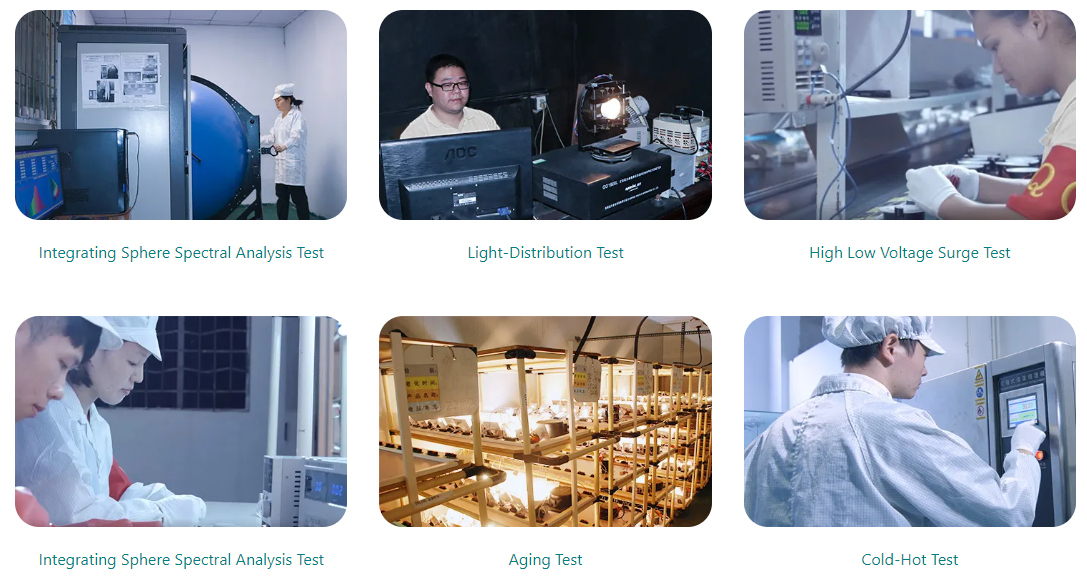
Minimum acceptable on-site laboratory equipment:
Equipment | Purpose |
Integrating sphere | Lumen output, efficacy, CCT, CRI measurement |
Goniophotometer | Beam angle, luminous intensity distribution |
Electrical safety tester | Hi-pot, insulation resistance, leakage current |
LM-80 / TM-21 test capability | Long-term LED lumen depreciation data |
IP ingress protection test rig | IP rating verification (dust, water) |
Colour spectrometer | MacAdam ellipse and colour consistency |
Aging / burn-in rig | Extended energised soak testing at elevated temperature |
Aging test (burn-in): A factory without a thermal aging rig cannot identify early-life driver failures before shipment. Minimum acceptable: 48-hour energised soak at 45–55 °C ambient for commercial-grade luminaires destined for demanding environments.
Sample approval gate: Confirm that the programme includes a formal sample approval stage — signed-off golden samples held by both parties — before production release. This is the contractual and quality anchor for the entire production run. Any factory that treats sampling as informal or advisory is signalling a tolerance for production drift.
A factory that relies entirely on third-party test labs for photometric data cannot provide in-process quality control — only end-of-batch sampling.
4. Supply Chain Depth and Managed Outsourcing
What to ask: Which production processes are in-house, and which are outsourced? How do you manage quality at outsourced processes?
Why this matters: A typical LED luminaire involves 6–8 discrete production processes: die casting, powder coating, PCB assembly, LED binning and soldering, driver assembly, optical assembly, wiring, and final QC. Very few factories do all of these in-house.
What good looks like: The manufacturer clearly names its outsourced processes, names the specific approved suppliers for each, and has a documented incoming inspection process (IQC) for each sub-assembly. Supplier audits on a defined cycle.
Red flag: "We control everything in-house" from a factory that clearly occupies a single building. Impossible. Evasiveness about sub-suppliers is a supply chain transparency failure.
5. Certification Management
What to ask: Which certifications do you hold, and how do you manage certification for new products developed for my market?
Market | Key Marks |
European Union | CE (LVD + EMC), DALI-2 (if applicable), ErP compliance |
Australia / New Zealand | RCM (previously C-Tick / A-Tick) |
USA | UL or ETL listed; Energy Star (if applicable) |
Germany | TÜV or VDE driver testing often customer-expected |
What good looks like: The factory has experience managing certification for your specific target markets, can nominate its approved test labs, and includes certification management in the ODM programme — not as an aftercharge.
6. Exclusivity and IP Protection Provisions
What to ask: If you develop a product to my brief, what protection do I have against the design being sold to a competitor?
What good looks like: A written exclusivity clause in the supply agreement, scoped by product SKU and market region, with a defined minimum annual volume threshold to maintain exclusivity. Tooling ownership defined in the contract (buyer-owned tooling is the preferred protection).
Red flag: Reluctance to discuss exclusivity, or vague verbal assurances without contractual backing. In commercial lighting, a design that appears in a competitor's catalogue 12 months after your ODM investment is a genuine commercial harm.
7. Logistics and Export Capability
What to ask: Do you manage export documentation and logistics, or does your responsibility end at the factory gate?
What good looks like: The manufacturer manages export documentation (packing lists, commercial invoice, country of origin certificate, test reports for customs), can work to EXW, FOB, or CIF terms depending on your preference, and has experience with the logistics requirements of your target markets (including REACH/RoHS documentation for EU import).
Why it matters for commercial lighting brands: Carton labelling, pallet configuration, and import documentation errors at scale mean customs delays that cascade into project site delays. A manufacturer that manages logistics as part of the programme — not as an afterthought — removes a major operational risk.
8. Communication Structure and Project Management
What to ask: Who is our single point of contact throughout the programme — from brief to final delivery?
Why this matters: A common failure mode in China-based manufacturing is the "revolving door" account manager — the salesperson who closes the order, the engineer who takes the brief, the QC manager who signs off the samples, and the logistics coordinator who books the shipment are four different people who do not always share information.
What good looks like: A dedicated project manager who owns the account across all stages — brief, sampling, tooling, production, QC, and shipping. This "one window" structure means changes and problems surface to a single owner, not disappear between departments.
Red Flags Summary Table
Red Flag | What It Likely Means |
"We can modify the existing model" for a fundamental change | Catalogue assembly, not ODM |
No ISO 9001:2015 certification or expired certificate | Quality management is informal |
IQC/IPQC/OQC process cannot be described in detail | Quality control is end-of-batch only |
No aging test rig on-site | Early-life failures ship undetected |
No formal sample approval gate before production | Production drift has no reference anchor |
AQL level unspecified or "we check everything" | Sampling is arbitrary, not statistical |
Reluctance to share sub-supplier names | Supply chain transparency failure |
All photometric data comes from external labs only | No in-process QC |
Vague exclusivity assurances, no contract language | Your design will be shared |
Multiple contacts at every stage, no single owner | Communication failures at scale |
A European commercial lighting brand used this checklist to screen 12 factories → shortlisted 3 → selected 1 ODM partner.
Using This Checklist
Run every potential supplier through all eight points before awarding an ODM programme. Request evidence — not assurances — at each step: ISO 9001:2015 certificate, IQC/IPQC/OQC documentation, AQL sampling plans, traceability records, aging test procedures, golden sample approval records, equipment photos, draft contract language, and named sub-suppliers.
A manufacturer that meets all eight criteria is positioned to operate as a genuine extension of your product development and supply chain function. One that fails on three or more should be treated as a production resource only — not an ODM partner.
Applying These Evaluation Criteria in Practice
The eight criteria above provide a practical framework for evaluating any commercial LED ODM manufacturer.
At ANOVA Lighting, these principles are integrated into our product development process—from engineering review and prototype validation to quality control, certification support, and production planning.
For example, rather than treating certification as a separate service after product development, compliance considerations are incorporated during the design stage to help reduce redesign work later in the project.
Similarly, quality verification extends beyond final inspection through documented IQC, IPQC, and OQC procedures, supported by in-house laboratory testing and production traceability.
While every project has different technical requirements, applying a structured engineering and quality management process helps improve consistency throughout development and manufacturing.

Planning a New ODM Lighting Project?
If you're evaluating manufacturing partners or developing a new commercial lighting product, our engineering team can help review your technical requirements and discuss practical manufacturing approaches based on your project objectives.
Contact ANOVA's Engineering Team
FAQ
Q1: How do I know whether a China LED manufacturer is a true ODM supplier?
A1: A genuine ODM manufacturer should have in-house engineering capabilities covering optical design, mechanical development, thermal management, and electrical engineering. Instead of offering only cosmetic modifications, they should be able to develop products based on your technical specifications and application requirements.
Q2: What certifications should a commercial LED lighting manufacturer provide?
A2: Certification requirements depend on the destination market. Common examples include CE and ErP for the European Union, RCM for Australia and New Zealand, and UL or ETL for North America. Manufacturers should also be familiar with the certification process and documentation required for each market.
Q3: Why is in-house testing important for LED lighting manufacturers?
A3: In-house laboratories enable manufacturers to verify optical performance, electrical safety, thermal reliability, and product consistency throughout development and production. Early testing helps identify issues before large-scale manufacturing begins.
Q4: Is ISO 9001:2015 certification enough when selecting an LED manufacturer?
A4: ISO 9001:2015 is an important indicator of a structured quality management system, but it should be supported by documented inspection procedures, laboratory capabilities, and consistent manufacturing processes.
Q5: What questions should I ask before selecting an ODM lighting manufacturer?
A5: Consider asking about:
● Engineering capability
● Driver development
● Quality management
● Certification experience
● Supply chain management
● Intellectual property protection
● Export experience
● Project communication
Suggested Related Articles
● EU vs AU Lighting Compliance Checklist
● Lighting Factory Quality Control Systems Explained