
Why IP65/IP67 Recessed Lights Fog - and How to Reduce the Risk
An outdoor recessed luminaire can pass an ingress-protection test and still develop internal condensation during repeated temperature and humidity cycles. The reason is simple: IP testing and condensation control answer different engineering questions. IP testing evaluates protection against specified solid and water ingress conditions. Condensation depends on moisture availability, pressure cycling, vapor transport, surface temperature and dew point.
For professional buyers, the correct question is not, "Which gasket or vent guarantees a fog-free fixture?" It is, "Which enclosure architecture and validation plan reduce moisture risk for this installation, duty cycle and target IP rating?"
Engineering answer: Use a vented, sealed or hybrid moisture-control architecture according to enclosure volume, temperature change, cable-entry design, installation position and service environment. Then validate the complete luminaire - not only the vent or gasket component.
Key Takeaways for OEM/ODM and Project Buyers
● An IP65 or IP67 rating does not, by itself, prove that a luminaire will remain free of internal condensation throughout its service life.
● Pressure equalization can reduce stress on seals and help limit pressure-driven moisture ingress, but a vent does not make enclosure design or final IP testing unnecessary.
● Gasket performance depends on the actual elastomer grade, geometry, compression, temperature profile, chemical exposure and assembly control - not only on whether the material is called silicone or EPDM.
● Recessed fixtures require special attention because concrete, masonry, soil and shaded exterior walls can create strong thermal and moisture gradients around the enclosure.
A credible supplier should provide traceable material data, an integrated enclosure test plan, production controls and clear change-management rules.
1. Why Passing an IP Test Does Not Automatically Prevent Condensation
The IEC 60529 IP Code classifies protection provided by electrical enclosures against access, solid foreign objects and water under defined test conditions. It does not claim that every compliant enclosure will remain condensation-free under every real installation and thermal cycle.
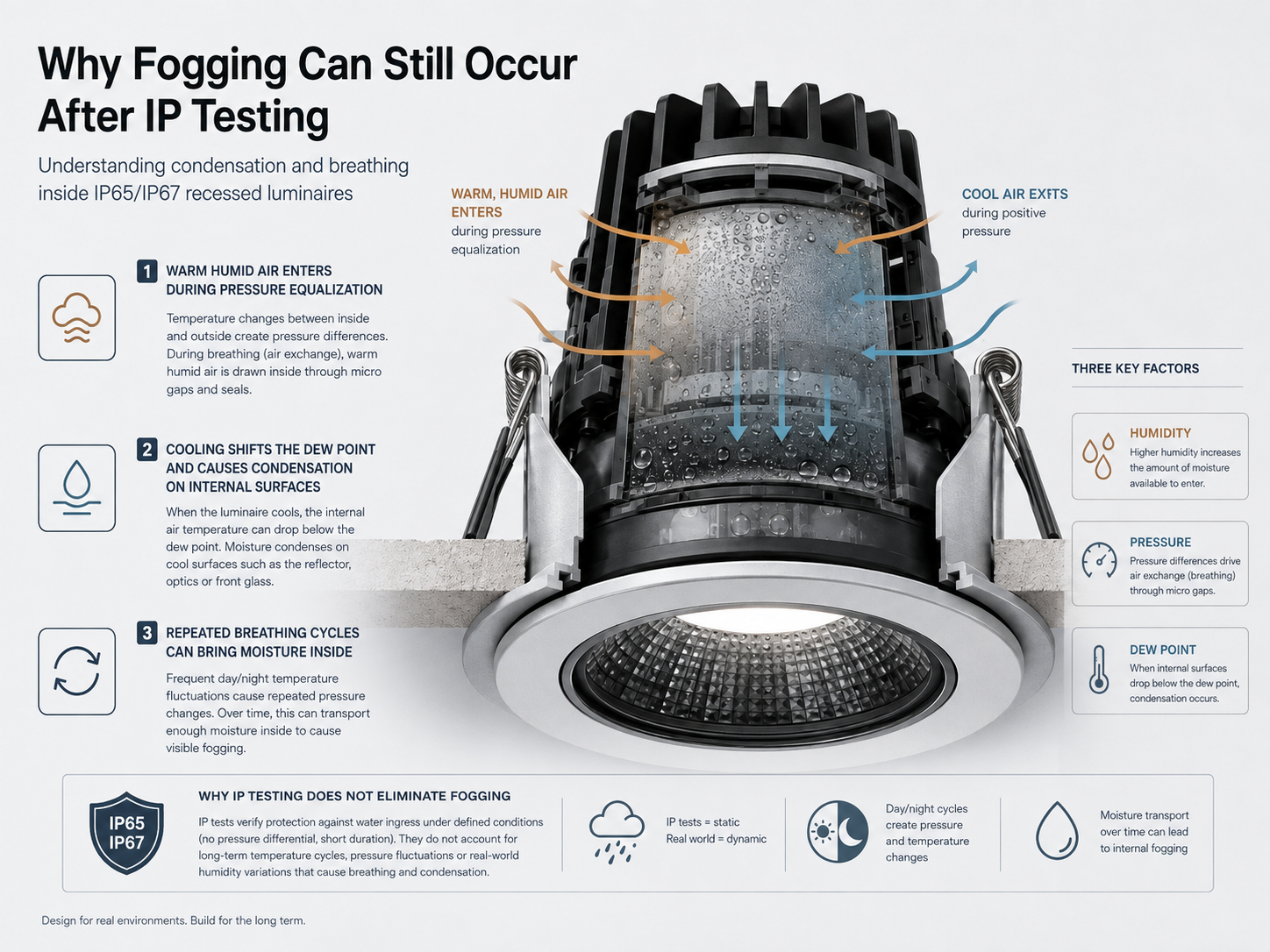
This distinction matters for outdoor step lights, wall-recessed markers and in-ground luminaires. A fixture may resist the specified water exposure and still contain moisture vapor from assembly, installation, cable pathways or repeated exchange with the environment. If an internal surface falls below the local dew point, that vapor can condense on the lens, reflector, PCB or driver housing.
The three conditions behind internal fogging
1. Moisture is present. It may originate from humid assembly air, cable entries, seals, permeation, installation cavities or previous exposure.
2. Temperature changes create pressure and surface-temperature differences. Heating and cooling cycles can stress seals and move air or vapor through available pathways.
3. A surface reaches the dew point. The lens or another internal component becomes cool enough for vapor to condense.
Because these conditions interact, simply tightening screws or adding more sealant may not solve the root cause. It can also make servicing less predictable or create uneven gasket compression.
2. Why Recessed Outdoor Fixtures Need a Different Risk Review
Recessed luminaires do not operate in free air. Their housings may be surrounded by concrete, masonry, insulation or soil. These materials affect heat flow, drainage and the humidity around cable entries and rear housings. The front bezel may experience solar heating or cold rain while the rear housing remains thermally coupled to the installation cavity.
A design review should therefore consider:
● enclosure volume and expected internal temperature change;
● front-to-rear temperature gradient and likely cold surfaces;
● installation orientation, drainage and vent position;
● cable gland, conduit and splice-box pathways;
● gasket cross-section, retention groove, compression and assembly torque;
● coastal salt, cleaning chemicals, UV exposure and local humidity;
● serviceability, repair method and expected maintenance interval.
ICP relevance: For a brand owner or project engineer, the commercial risk is larger than the fixture price. A moisture-related failure can create access costs, installation downtime, warranty claims, batch investigations and reputational damage.
3. Choosing a Vented, Sealed or Hybrid Architecture
There is no universal architecture for every IP65/IP67 recessed light. The correct option depends on the pressure profile, available mounting area, contamination exposure, enclosure geometry and validation evidence.
| Architecture | Best-fit conditions | Engineering advantage | Evidence required |
| Vented enclosure | Repeated thermal cycles; sufficient protected mounting area; pressure equalization is a design priority | Reduces pressure differential and seal stress; supports vapor diffusion | Vent selection and position; liquid-barrier performance; complete-luminaire IP and environmental testing |
| High-integrity sealed enclosure | Compact cavity; vent integration is impractical; pressure change is manageable by design | Simpler external architecture; controlled sealing interface | Gasket grade and geometry; cable entry; pressure/leak test; thermal and humidity cycling |
| Hybrid architecture | High-risk installations combining strong thermal cycling, complex cable paths or demanding service conditions | Uses pressure management plus resilient sealing and controlled drainage | System-level DFMEA; integrated IP test; environmental validation; production control plan |
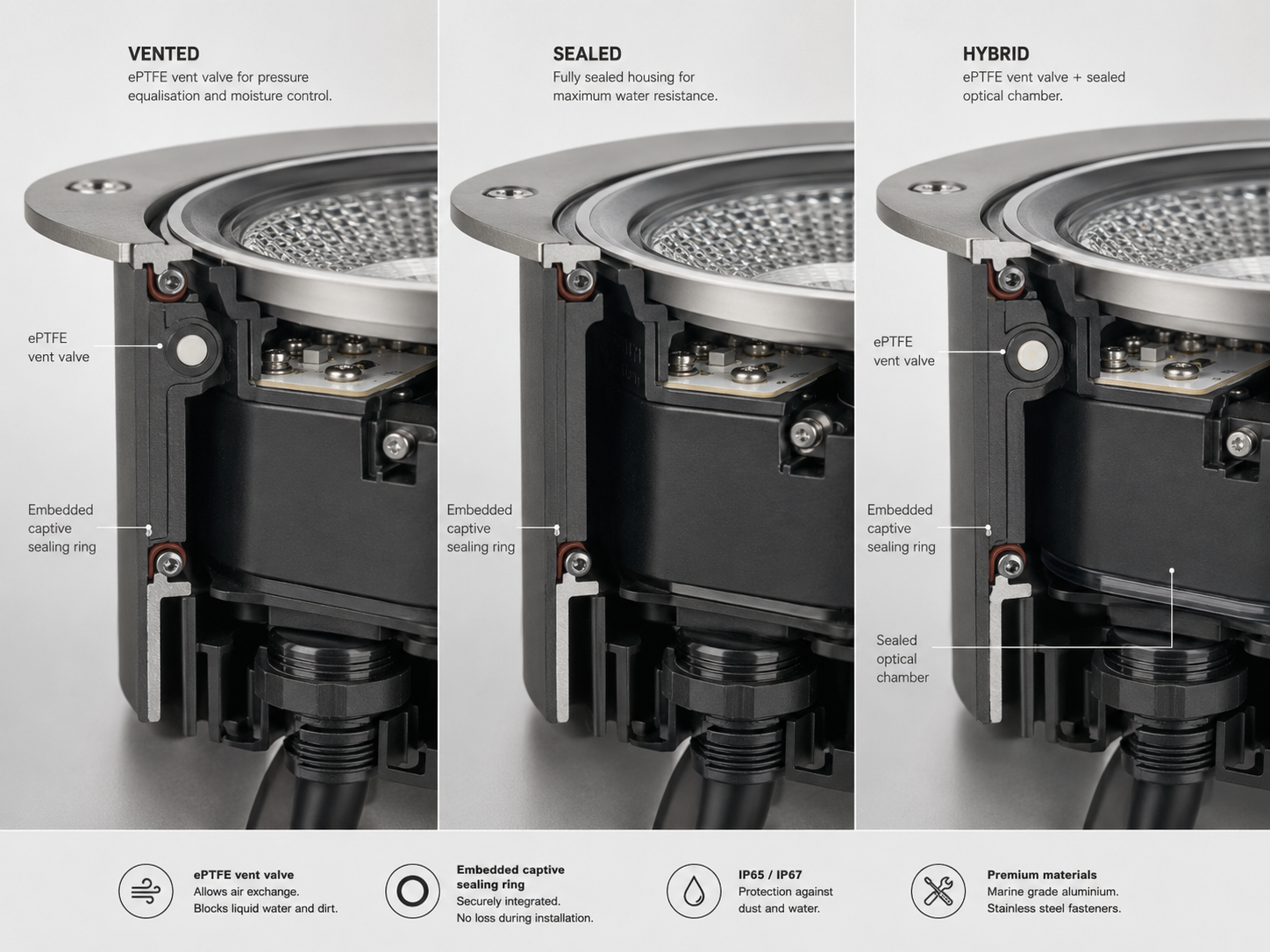
Application guidance from Gore for lighting enclosures explains that protective vents can rapidly equalize pressure, reduce stress on housing seals and minimize condensation through vapor diffusion while maintaining a barrier to liquids and particulates. The final performance still depends on vent selection, placement, installation and enclosure testing.
4. Turning Engineering Features into Buyer Value
Professional buyers do not need another list of materials. They need to understand how a design choice changes project risk, lifecycle cost and supplier accountability.
| Feature | Engineering advantage | ICP business benefit | Proof to request |
| Application-sized ePTFE vent | Helps equalize pressure while providing a liquid and particle barrier | Lower risk of pressure-driven leakage, seal fatigue and fogging-related callbacks | Vent data sheet, sizing basis, installation drawing and integrated enclosure test |
| Retained elastomeric gasket | Controls gasket location and compression during assembly | More consistent sealing across production batches and service events | Material specification, groove drawing, compression range and assembly control |
| Pressure-decay or leak test | Detects defined assembly leakage before shipment | Reduces batch escape risk and supports traceable quality decisions | Test method, acceptance limit, calibration and sampling or 100% inspection rule |
| Environmental validation plan | Tests the design against relevant moisture, temperature and corrosion stresses | Improves project confidence and reduces late redesign or qualification delays | Approved test plan, sample configuration, report and deviation record |
5. What a Credible Validation Plan Should Include
A test standard is not a marketing badge. It is a defined method that must be matched to the product requirement, test condition and acceptance criterion. Before qualification, the buyer and supplier should agree on the following sequence.
1. Define the use case: target IP rating, installation orientation, ambient range, switching cycle, cleaning exposure, coastal or chemical environment and service life expectation.
2. Review moisture pathways: lens seal, bezel interface, housing joint, fasteners, vent interface, cable gland, conduit and rear installation cavity.
3. Verify material evidence: actual gasket compound, hardness, chemical compatibility and compression-set data under a relevant test condition.
4. Validate the complete enclosure: test the production-intent luminaire with its vent, gasket, cable entry, fasteners and assembly process.
5. Define production controls: torque, gasket inspection, leak-test limits, vent handling, traceability and nonconformance rules.
6. Control engineering changes: repeat the risk review when the vent, gasket compound, cable gland, housing machining, coating or assembly process changes.
| Reference | What it addresses | Responsible use in a specification |
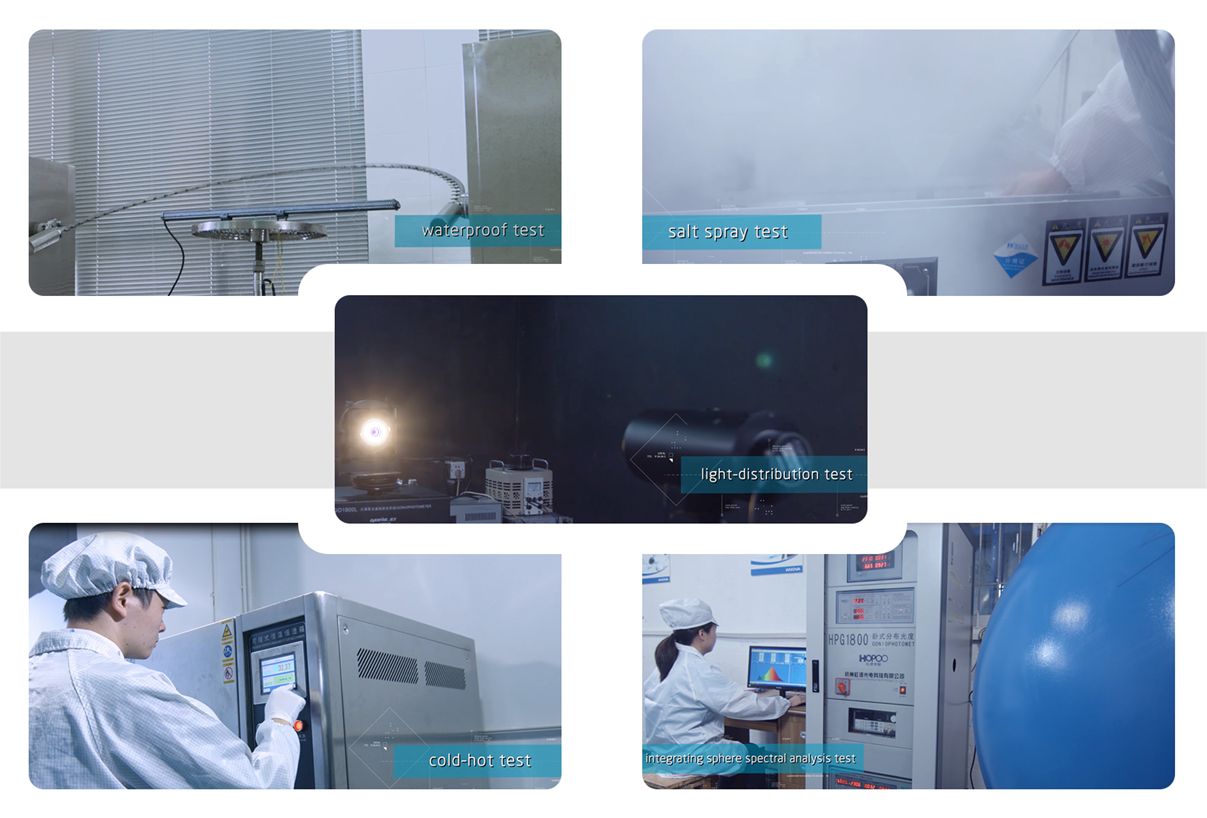
| IEC 60529 | Ingress-protection classification for electrical enclosures | Use the complete production-intent luminaire and target classification. |
| IEC 60068-2-30:2025 | Cyclic damp-heat procedure involving high humidity and temperature change | Select severity and acceptance criteria according to project requirements. |
| ASTM D395-18(2025) | Compression-set test methods for rubber compounds | Report material grade, method, temperature, duration, deflection and result. |
| ISO 9227:2022 | Salt-spray test methods for evaluating coating or material defects | Do not use salt-spray hours alone to predict field life or rank unrelated materials. |
6. Supplier Qualification Checklist for Professional Buyers
● Is the IP claim supported by a report for the complete luminaire configuration being purchased?
● Does the bill of materials identify the exact vent and gasket grade rather than a generic material family?
● Are cable entries, rear cavities, drainage and installation instructions included in the moisture-risk review?
● Are test samples production-intent, and are the sample quantity and pass/fail criteria documented?
● Can the supplier explain which test controls water ingress, which test addresses humidity cycling and which test addresses corrosion exposure?
● Is there a defined leak-test or pressure-decay method for production, with calibrated equipment and traceable results?
● Will material or process changes trigger documented requalification?
● Can project drawings, optical requirements and custom mechanical details be handled under agreed confidentiality terms?
7. ANOVA's Engineering-First Collaboration Model
ANOVA approaches moisture control as an enclosure-system problem. The engineering discussion begins with the installation, thermal profile, enclosure geometry, cable path and target compliance package - not with a predetermined gasket or vent recommendation.
For OEM/ODM and project programs, the proposed scope can include housing and sealing-interface review, vent or gasket selection input, design-for-manufacture feedback, prototype planning and a project-specific validation checklist. Scope, test availability and acceptance criteria should be confirmed for each project before they are represented as deliverables.
For confidential developments, project drawings and custom specifications can be reviewed under mutually agreed confidentiality terms. This supports engineering collaboration without turning protected customer designs into public marketing material.
Frequently Asked Questions
Can a luminaire with a protective vent still meet IP67?
Yes, it can, provided the selected vent, installation interface and complete enclosure pass the applicable test for the target rating. A component-level vent rating alone does not certify the finished luminaire.
Why can an IP67 recessed light fog after it passes an IP test?
An IP test evaluates specified ingress conditions. Fogging can occur later when moisture is present and an internal surface falls below the dew point during real temperature and humidity cycles.
Does an ePTFE vent block all moisture?
No. A protective vent is designed to allow gas and moisture vapor transport while resisting liquid water and particulates within its specified performance limits. It can reduce condensation risk, but it does not remove the need for good enclosure design, drainage and validation.
Is liquid silicone rubber always better than EPDM?
No. Material-family names are not enough to predict sealing life. Compare the actual compound, hardness, compression-set result, chemical compatibility, temperature exposure and gasket geometry for the application.
Do compact recessed step lights always need a vent?
No. Some compact designs can use a high-integrity sealed architecture, while others benefit from a vented or hybrid solution. The decision should follow pressure, moisture-path and environmental analysis rather than fixture size alone.
What evidence should an OEM/ODM buyer request?
Request the complete-luminaire IP report, vent and gasket specifications, relevant environmental-test reports, production leak-test controls, installation requirements and change-management rules.
Reduce Moisture Risk Before It Becomes a Site Callback
The most reliable time to address condensation is before tooling release and project qualification. A short engineering review can identify missing inputs, unsuitable assumptions and evidence gaps while changes are still manageable.
Request an Engineering Moisture-Risk Review:Send the enclosure volume, wattage, housing material, cable-entry design, installation orientation, ambient range and target IP rating. ANOVA can use these inputs to discuss a suitable vented, sealed or hybrid architecture and the validation evidence required for your project.
Technical References
1. IEC 60529 - Degrees of protection provided by enclosures (IP Code) - Official IEC standard page.
2. IEC 60068-2-30:2025 - Damp heat, cyclic - Official IEC environmental-test standard page.
3. ASTM D395-18(2025) - Rubber property: compression set - Official ASTM method and scope.
4. ISO 9227:2022 - Salt spray tests - Official ISO standard page and stated limitations.
5. GORE Protective Vents for Lighting Enclosures - Application guidance on pressure equalization, vapor diffusion and enclosure protection.