
Tunable White vs Tri-CCT vs RGBW: A Module Selection Checklist for Lighting Buyers
Tunable White vs Tri-CCT vs RGBW: A Module Selection Checklist for Lighting Buyers
For lighting wholesalers and importers, the choice between Tunable White, Tri-CCT and RGBW affects more than the colour of the light. It changes the LED module specification, driver requirement, control method, sample process and purchase-order details.
The first selection question is simple: does the customer need continuous white-light adjustment, three fixed CCT choices, or colour scenes as well as white light? Tunable White supports continuous adjustment between defined warm and cool endpoints. Tri-CCT provides three preset white temperatures. RGBW adds red, green and blue colour output with a dedicated white channel.
This checklist focuses on product and control selection. It does not cover lighting-system architecture or engineering design. For every option, treat the module, driver and controller as one combination to be confirmed before bulk release.
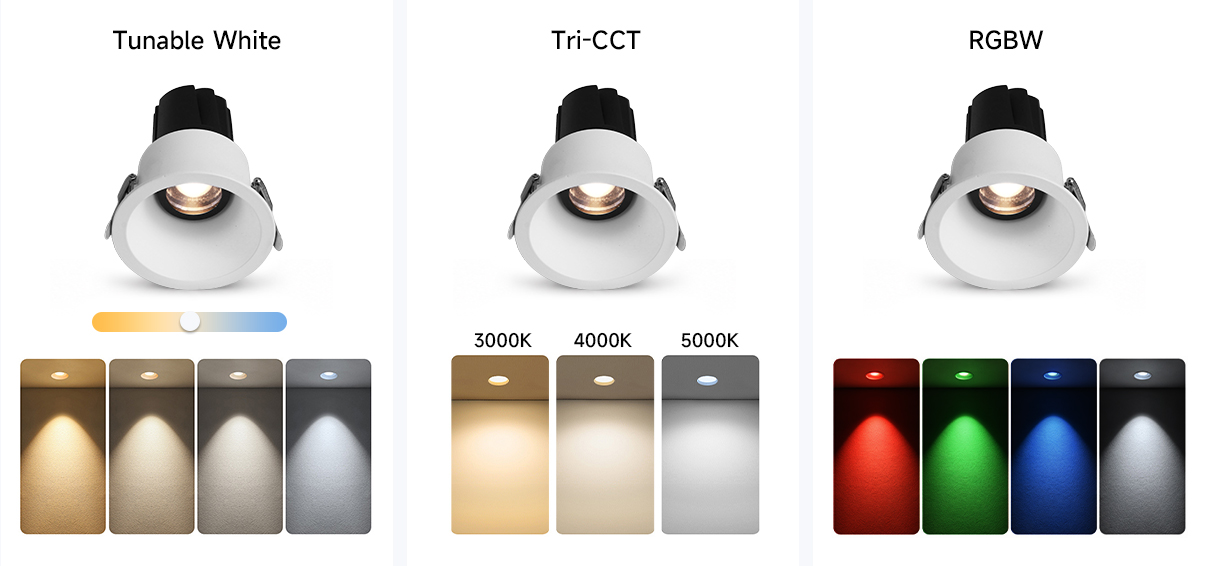
Three module types address different requirements: continuous CCT adjustment, preset CCT selection and colour scenes with dedicated white light.
Key takeaways
● Select Tunable White when users need to adjust CCT continuously during normal operation.
● Select Tri-CCT when three fixed CCT settings can cover the market requirement with simpler product selection.
● Select RGBW when colour scenes are needed and the white channel must still perform as everyday lighting.
● Confirm the exact module, driver and controller combination before approving a bulk order.
● Use a golden sample, clear PO specifications and substitution control to prevent costly compatibility changes.
What is the difference between Tunable White, Tri-CCT and RGBW?
Tunable White
Tunable White modules blend warm and cool white output to adjust correlated colour temperature across a defined range. They suit residential, hospitality, retail and smart-lighting applications where the white appearance should change after installation.
24V DC Tunable White MR16 Module is available in CB5030TW, CB5050TW and CB5070TW versions. Its listed 2700K-6500K range gives buyers a practical reference for projects requiring both warm ambient light and cooler task-oriented white light. IP20/IP65 versions and 15°, 24°, 36° and 60° optical choices make it relevant for several low-voltage spot and downlight formats.
Confirm the rated power, channel arrangement and driver load capacity for the exact module before approving an RFQ or bulk order.
Continuous adjustment does not happen through the module alone. The driver must support the module's channel configuration, and the chosen controller must be able to address colour temperature as well as brightness. This is the main difference between a genuine Tunable White buying decision and a standard dimmable-white product.
Tri-CCT
Tri-CCT provides three selectable white temperatures rather than a continuous range. The setting is normally selected during installation through a switch, DIP setting or product-specific selector. It is often the most practical option when distributors want to cover several market preferences without keeping separate fixed-CCT SKUs.
Tri-CCT COB Module Light is available as CB5080SR and CB5080SL. Typical selectable sets include 3000K/4000K/5000K and 2700K/4000K/6000K, with customised sets available subject to confirmation. Multiple beam-angle options also allow the same product direction to serve different optical requirements.
Tri-CCT should not be positioned as Tunable White. Once installed, CCT adjustment requires physical access to the selector rather than app, wall-control or scheduled adjustment. Its value is operational simplicity and inventory flexibility, not dynamic CCT control.
RGBW
RGBW combines red, green, blue and white channels. It is suitable for decorative, hospitality, retail and scene-driven applications where colour effects are required, but white light must remain useful for normal daily operation.
DC 24V RGBW LED MR16 Module is available as VB5070RGBWL and VB5070RGBWR. It combines RGB output with a cool-white or warm-white option and operates at DC 24V. Its listed Ra>90 specification, IP20/IP65 versions and 15°, 24°, 36° and 60° beam-angle choices make white-light quality and optical selection part of the buying decision, not an afterthought.
Confirm the rated power, driver output and controller configuration for the selected RGBW version before approval.
For RGBW, specify the white channel separately from the colour effects. A good colour scene does not prove that the module delivers the required white CCT, colour rendering or appearance for normal lighting use.
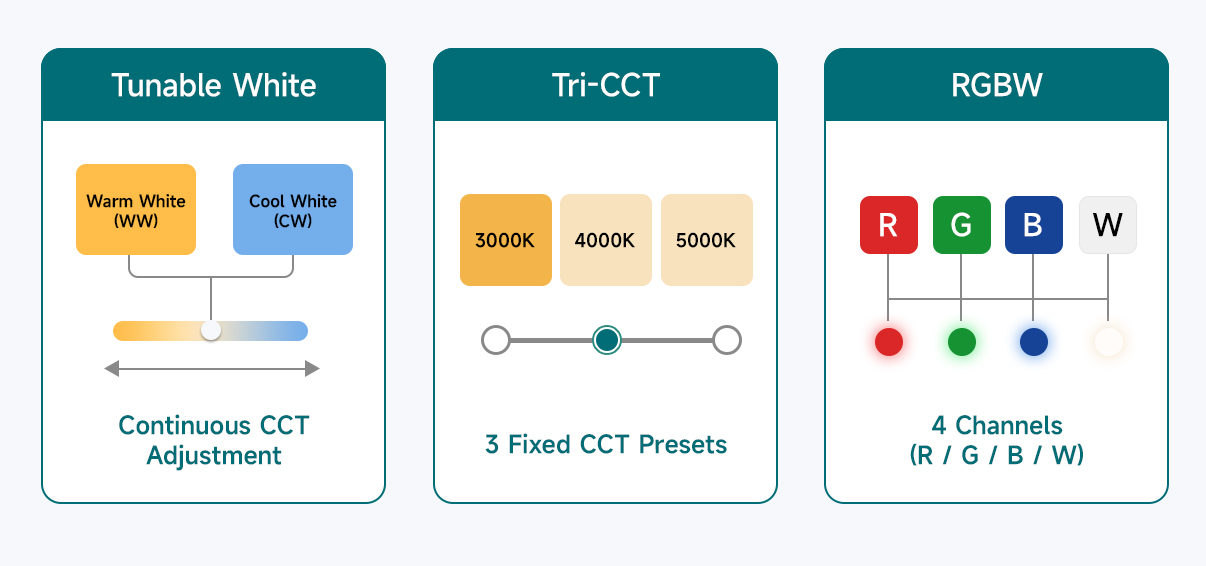
Tunable White, Tri-CCT and RGBW require different control logic and purchasing checks.
Which module fits each buying requirement?
| Buying requirement | Recommended choice | Why it fits | Check before approval |
| Adjustable warm-to-cool white light | Tunable White | Continuous CCT adjustment during use | CCT range, driver channels, controller and dimming behaviour |
| Three selectable white temperatures | Tri-CCT | One product can cover several preset preferences | Exact CCT set, selector location and product labelling |
| Colour scenes plus usable white light | RGBW | Dedicated white channel supports routine lighting | White version, CRI, driver channels and scene control |
| SKU consolidation for standard projects | Tri-CCT | Reduces fixed-CCT variation | Local market CCT demand and installation method |
| Smart low-voltage lighting | Tunable White or RGBW | Supports dynamic control where confirmed | Input voltage, load, controller and commissioning method |
| Decorative retail or hospitality lighting | RGBW | Supports branding, colour effects and white-light operation | Static/dynamic scene requirement and low-output mixing |
The table is a shortlist tool. It does not establish electrical or protocol compatibility. Final selection should always be based on the actual module, proposed driver and intended control method.
What should buyers check for Tunable White modules?
Start with the required CCT endpoints. Record the stated range on the RFQ and confirm that it meets the customer's warm and cool white requirements. Do not assume that all Tunable White modules use the same range.
Next, confirm the electrical relationship between the module and driver. Record input voltage, output type, channel arrangement, rated load and dimming interface. A driver suitable for a single-channel white module may not control a Tunable White module correctly.
Where DALI is requested, the PO should state the required colour-control function, not just "DALI." The DALI Alliance colour-control guidance identifies Tc as the colour-temperature control type used for Tunable White and DT8(Tc) as the associated device-type designation. A driver must support that function; the presence of a DALI label alone is not sufficient.
Finally, test dimming and CCT adjustment together. The sample review should cover full output, low dimming levels, fading, CCT response and the intended operating range. This is especially important for products that will be controlled by an app, wireless ecosystem or scene controller.
What should buyers check for Tri-CCT modules?
Write all three preset values into the RFQ. "Tri-CCT" is incomplete because different projects may require 2700K/4000K/6000K, 3000K/4000K/5000K or a customised combination.
Confirm how the installer makes the selection. Is it a rear switch, front switch, DIP switch or another method? Can the selector be reached after installation if a customer later changes preference? These practical details influence suitability for downlights, cabinet lighting, retrofit work and distributor stock programmes.
Separate CCT selection from dimming. Some Tri-CCT products can be paired with Triac, 0–10V or DALI dimming options, but dimming changes brightness; it does not turn a three-preset module into continuously adjustable white light. Confirm the actual driver and dimmer or controller before order approval.
During sampling, inspect every CCT setting in the same environment. The golden-sample record should include the module reference, all selected CCT values, driver, dimmer or controller, settings and approval date.

For Tri-CCT products, the preset values and selector accessibility are key purchasing details.
What should buyers check for RGBW modules?
First, define the white-light requirement. Specify warm white or cool white, required CCT, CRI, colour consistency and expected daily use. This prevents a project from approving attractive RGB effects while overlooking the quality of its normal white lighting.
Second, define the colour-control requirement. The DALI Alliance guide to device types explains that DT8 is associated with DALI colour control. In DALI colour control, RGBWAF is the relevant colour type for RGB-style channel control. However, protocol terminology does not replace product-level testing. The proposed driver and controller must be confirmed for the selected RGBW module and intended function.
Third, test low-output performance. Inspect the sample for visible colour separation, uneven mixing, unstable fading or an unexpected shift in white output. These issues may not be apparent at full brightness.
Finally, define whether the application needs static colours, changing scenes, white-only operation or all three. This determines the required controller capability and who will be responsible for commissioning.
What should be recorded in a compatibility check?
Use one compatibility record for each selected combination:
● Module item number, voltage, power, channel arrangement and optical option
● CCT range, Tri-CCT presets or RGBW white-channel version
● Driver brand, model, output type, output range, channel count and dimming interface
● Controller, dimmer or wireless platform model
● Required function: dimming, Tunable White CCT adjustment, RGBW scenes or other control
● Tested settings, sample quantity, test date and result
● Golden-sample reference, approval record and responsible reviewer
Similar connectors, matching voltage labels or similar product-family names are not proof of compatibility. Any substitution to a module, driver, controller or dimmer should trigger a new technical review and sample check.
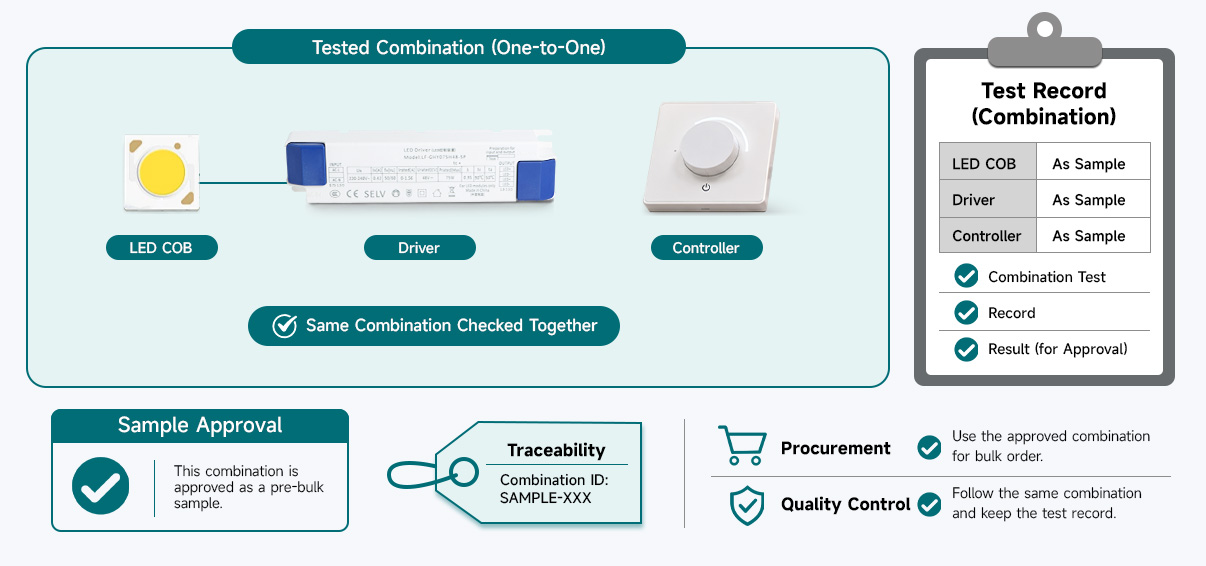
A traceable module-driver-control record is the basis for confident bulk approval.
What should be included in a bulk purchase order?
A bulk PO should identify the exact module version, optical configuration, selected CCT values or white-channel version, IP rating, driver model and intended control method. It should also reference the approved golden sample and state that no substitution is permitted without written approval.
For colour consistency, agree on the required target and inspection method before production. Check more than one carton or one sample where the order volume justifies it. Product labels, carton labels and installation instructions should reflect the same CCT-selection and control information agreed during sampling.
Buyers can also review ANOVA's commercial FAQ for current information on minimum order quantity, lead time and dimming availability. Final configuration, pricing and delivery commitments should be confirmed for the specific order.
For a module shortlist, technical confirmation or sample plan, contact sales@anovalighting.com with the required module type, CCT requirement, estimated quantity and any existing driver or controller under consideration.
FAQ
What is the difference between Tunable White and Tri-CCT?
Tunable White adjusts CCT continuously between defined endpoints during normal use. Tri-CCT offers three preset CCT settings selected during installation.
Can a Tri-CCT module reduce the number of SKUs?
Yes, when its three preset values match the market requirement. Confirm the CCT set, selector method and labels before using it as an inventory-consolidation product.
Does DALI compatibility guarantee that a module will work with my controller?
No. Confirm the required colour-control function, driver output, controller model and tested module-driver-controller combination.
Can RGBW provide everyday white light?
Yes, provided that the dedicated white channel is specified for the intended CCT, CRI and visual requirement. Do not assess white-light quality from RGB mixing alone.
What happens if a driver or controller changes after sample approval?
Treat the change as a new compatibility review. Reconfirm the combination and approve a new sample before bulk production.