
Anti-Glare Downlight Specification: How Do You Turn Marketing Terms into PO Fields?
Anti-Glare Downlight Specification: How Do You Turn Marketing Terms into PO Fields?
Two suppliers may quote the same "anti-glare" downlight, yet their documents can describe very different products. One may have a deep recessed source and a black baffle; the other may simply use a broad marketing label.
For a buyer, the useful question is not whether a quotation says "anti-glare." It is whether the order states the optical construction, the supporting photometric data, and the sample checks that make the claim reviewable.
This guide turns common anti-glare wording into practical fields for a downlight purchase order. It focuses on information that can be checked against an approved drawing, a photometric file, a signed sample record, or delivered goods. It does not promise glare performance for every room or application.
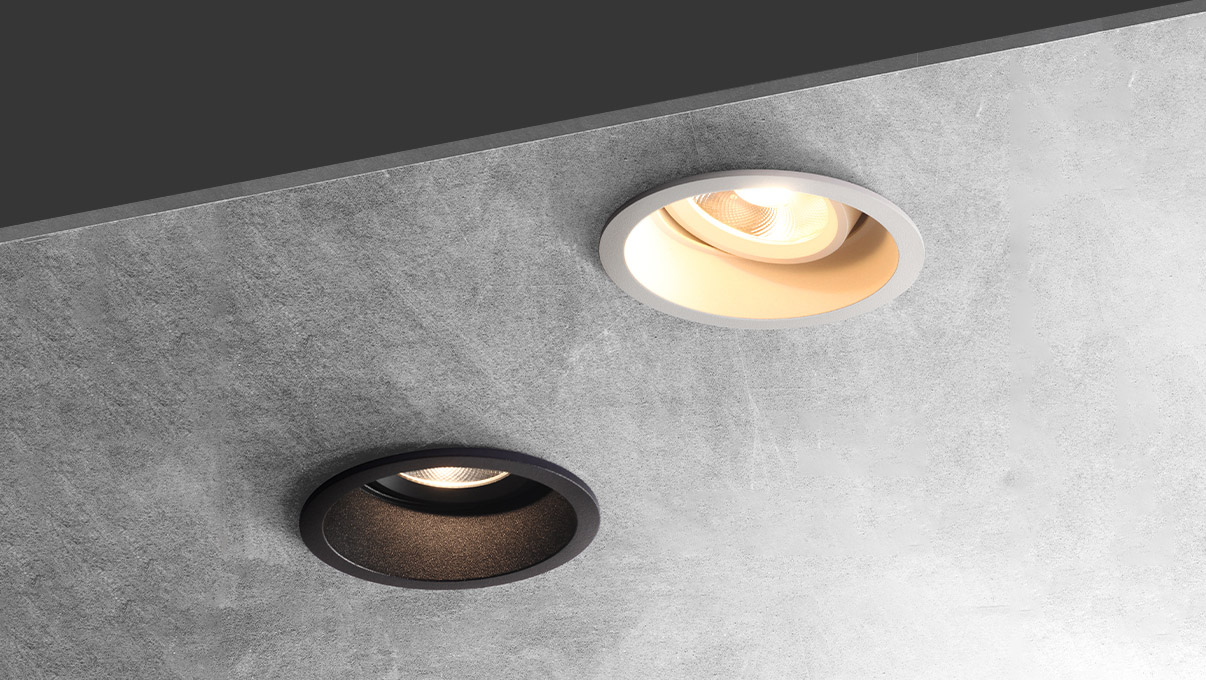
Same ceiling, two optical constructions: the specification fields identify the difference on paper.
Key takeaways
● "Anti-glare," "dark light," and "glare-free" are not purchase-order specifications by themselves.
● A useful anti-glare downlight specification records geometry, aperture treatment, beam data, photometric evidence, and the exact tested configuration.
● A UGR value needs its calculation conditions. It should not be treated as a universal property of one downlight.
● The approved sample, drawing, and IES/LDT file should refer to the same optical and electrical configuration.
● Goods receipt should compare the delivered fixture with the approved sample record, not with brochure wording.
Why Do Anti-Glare Claims Fail on a Purchase Order?
Marketing language can describe an intended benefit, but it does not identify a physical structure or a measurable condition. "Anti-glare" alone does not state the source recess depth, reflector geometry, internal finish, beam angle, or calculation basis behind a UGR claim.
A purchase order has a different purpose. It needs to identify what the supplier will deliver and what the buyer can check. If a line item cannot be compared with an approved drawing, physical sample, or photometric file, it is difficult to use as an acceptance criterion.
For that reason, treat every anti-glare phrase on a quotation as the start of a technical question:
● What physical feature is being described?
● Which field identifies that feature?
● What document or sample proves the field?
● Who checks it before and after bulk production?
This approach helps buyers compare like with like when reviewing a recessed downlight range, even when suppliers use different promotional terms.
Which Anti-Glare Terms Need to Be Translated into Specifications?
Several common terms may refer to real optical features, but none should be copied into a PO without supporting fields.
Dark light and deep-source
"Dark light" usually describes an appearance in which the bright source sits above the aperture and is less directly visible from typical viewing angles. "Deep-source" refers more specifically to source position: the LED module is recessed inside the housing.
On a PO, describe the relevant geometry instead of relying on either phrase. Useful fields include source recess depth in millimetres, shielding or cutoff angle in degrees, and the approved drawing revision.
Black baffle and honeycomb mesh
A black baffle is an internal ring or cone with a dark, low-reflectance surface around the aperture. A honeycomb mesh, louver, or snoot is a cell structure installed in front of the source.
These are useful procurement terms because the structures are visible and checkable. The order should name the baffle type, material or construction where relevant, internal finish colour, and the drawing or approved sample that defines the appearance.
Soft light and eye-care
"Soft light" may refer to diffusion, a wider beam, or a less visible hotspot. "Eye-care" is broader still. Neither is a reliable substitute for optical data.
If the project needs to control beam appearance or dimming behaviour, specify those items separately: beam angle, photometric file, driver model, dimming protocol, and sample observation at the intended operating levels.
Glare-free and anti-glare
"Glare-free" should not be accepted as a guaranteed project outcome. It may be used to describe a deep source, a baffle, a reflector, or simply a marketing position.
Use "anti-glare" only as a category label. The purchase-order fields should define the actual optical construction and the evidence required to review it.
Which PO Fields Make an Anti-Glare Downlight Checkable?
The table below converts common wording into fields that a buyer, supplier, and receiving team can review together.
| Marketing term | What it may describe | PO field to state | Evidence or acceptance check |
| Dark light / dark-light optic | A source positioned above the visible aperture | Shielding or cutoff angle, in degrees; approved drawing revision | Compare the sample and drawing |
| Deep-source | Recessed LED module | Source recess depth, in mm | Dimension the sample against the approved drawing |
| Black baffle | Dark internal ring or cone | Baffle type; internal finish colour; approved sample reference | Inspect under consistent lighting and compare with the approved sample |
| Honeycomb mesh / louver / snoot | Cell structure in front of the source | Baffle type; cell construction; finish colour; drawing reference | Inspect mesh construction and finish against the approved sample |
| Anti-glare reflector | A shaped reflector intended to control distribution | Reflector type; internal finish; approved drawing reference | Compare reflector geometry and finish with drawing and sample |
| Soft light / eye-care | Diffusion, beam appearance, or dimming comfort claims | Nominal beam angle; photometric file; driver and dimming method | Review the exact configuration file and observe the sample at agreed dimming levels |
| UGR < 19 | A calculated glare value produced under stated conditions | UGR limit plus calculation conditions and source data | Review the UGR table or calculation conditions with the applicable photometric file |
UGR requires particular care. The CIE's UGR method considers observer position and direction of view, while UGR tables use stated reference conditions. See CIE 117-1995 on discomfort glare in interior lighting and CIE 190:2010 on calculating and presenting UGR tables.
Therefore, do not write a UGR value as though it were an unconditional, stand-alone attribute of the fixture. Record the requested limit alongside the room assumptions, mounting height, spacing assumptions, observer conditions, and the IES or LDT file used for the calculation.
What Should Be Included in the Core Downlight PO Checklist?
For each anti-glare downlight line item, ask the supplier to identify the following fields in the quotation, drawing package, or approval record.
1.Product model and configuration code.
2.Approved drawing number and revision.
3.Source recess depth, in millimetres.
4.Shielding or cutoff angle, in degrees, where applicable.
5.Reflector type and internal finish.
6.Baffle type: none, ring, honeycomb mesh, louver, or snoot.
7.Internal finish colour visible at the aperture.
8.Nominal beam angle and agreed tolerance.
9.IES or LDT file for the exact configuration being purchased.
10.LED module, driver, reflector, baffle, and control-module configuration covered by the photometric file.
11.Required dimming method and confirmed compatibility conditions.
12.UGR requirement, if applicable, together with the stated calculation conditions.
13.Approved sample reference and sample approval date.
14.Carton, label, or batch-reference requirement for traceability between delivered goods and approved records.
If the order calls for DALI-2, identify the exact control gear and compatibility requirement rather than merely writing "DALI." Products marketed as DALI-2 should be checked against the DALI Alliance certification framework and, where relevant, the public certification database for the exact product configuration.
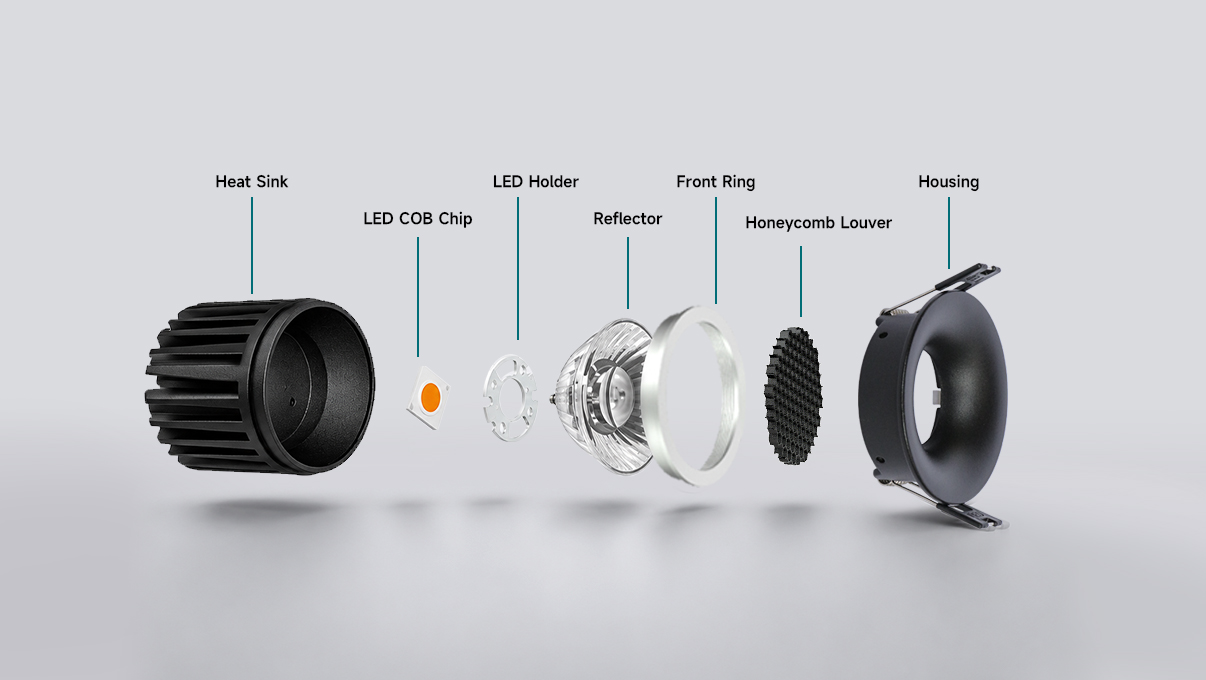
An exploded view identifies the optical and mechanical components that should be matched to the approved configuration.
What Should a Buyer Request Before Approving Bulk Production?
A golden sample is useful only when it represents the exact configuration that will be supplied. A stand-in sample with a different reflector, internal finish, driver, or baffle does not establish a reliable approval standard for the bulk order.
The approved sample record should identify:
● Product model and configuration code.
● Baffle and reflector type.
● Internal finish colour.
● LED module and driver.
● Beam angle.
● Dimming or control method.
● Drawing number and revision.
● IES/LDT file name or version.
● Approval date and sample reference.
● Photos of the aperture and optical assembly where appropriate.
Request three supporting items with the physical sample:
1. The approved drawing, including recess depth and optical-part dimensions.
2. The IES or LDT file for the same configuration as the sample.
3. A signed configuration record that ties the sample to its LED module, driver, reflector, baffle, and control method.

Production inspection helps keep the approved downlight configuration under review before bulk delivery.
For dimmable products, test the agreed sample at low, mid, and full output using the intended dimming method. Record the observed behaviour and beam appearance. This is a sample acceptance record, not a claim that the fixture will deliver the same visual comfort in every room.
Where available, a supplier's public manufacturing process information can help a buyer understand the production context. It should not replace configuration-specific drawings, samples, and photometric evidence.
Which Fields Should Be Checked at Goods Receipt?
Receiving teams do not need to reproduce a full lighting calculation at the loading dock. Their job is to confirm that delivered goods match the agreed record and that any deviation is identified before installation.
A practical goods-receipt check can include:
● Confirm the product model and configuration code.
● Compare the visible aperture, baffle type, internal finish, and reflector appearance with the approved sample.
● Verify that the supplied drawing revision and product labels match the order record.
● Inspect honeycomb mesh or louver construction where specified.
● Check the agreed beam appearance on an unpacked sample at full output, if a powered inspection is part of the receiving plan.
● Confirm that cartons or labels carry the agreed order, lot, or batch reference.
● Quarantine and document any mismatch before the goods are released for installation.
Use consistent inspection lighting and a documented comparison method. For example, a black baffle may look different under warm and cool ambient light, so the record should define the sample comparison conditions where appearance is important.
How Should Buyers Use UGR Without Overpromising Glare Performance?
UGR can be valuable when it is used with the correct conditions. It is not a substitute for project lighting design.
A UGR request should identify the target application, room assumptions, mounting height, fixture arrangement, relevant viewing conditions, and photometric file. The resulting value or table should be reviewed as part of the proposed lighting design.
The final glare assessment for a specific installation belongs to the project lighting designer or another suitably qualified professional. A purchase order can require the optical inputs and calculation evidence; it cannot guarantee the visual result in an undefined room.
How Can You Make Repeat Orders More Consistent?
Once the optical configuration and sample record are approved, repeat orders should reference the same controlled information rather than restarting with broad marketing language.
Use the approved model/configuration code, drawing revision, optical-component description, photometric-file reference, and sample approval record in the repeat order. If any one of these elements changes, treat it as a configuration change and review the changed sample or data before accepting it as equivalent.
For product availability, technical questions, or a quotation based on defined fields, contact Anova Lighting with the target configuration and the evidence you need to review.
FAQ
What does anti-glare mean on a downlight datasheet?
It is a broad description, not a complete specification. Ask which features support the claim: source recess depth, shielding angle, baffle type, reflector type, internal finish, beam data, and the relevant photometric file.
How should I specify UGR on a purchase order?
State the requested limit together with the calculation conditions and the photometric file used. Record room geometry, mounting height, fixture spacing, and viewing assumptions. Do not treat the UGR value as a universal result for every installation.
What is a black baffle downlight?
It is a downlight with a dark internal ring or cone at the aperture. On a PO, specify the baffle type and internal finish colour, then compare the delivered product with the approved sample and drawing.
Which photometric file should a downlight supplier provide?
Request an IES or LDT file for the exact configuration being purchased. The LED module, reflector, baffle, driver, and relevant control configuration should match the approved sample and order record.
Is "glare-free" a specification I can rely on?
No. Treat it as a prompt to request evidence, not as an acceptance criterion. The reliable fields are the documented geometry, optical components, photometric file, sample record, and applicable calculation conditions.