
Mini Spotlight vs Recessed Downlight for Retail Showcases
1. What This Guide Helps You Decide
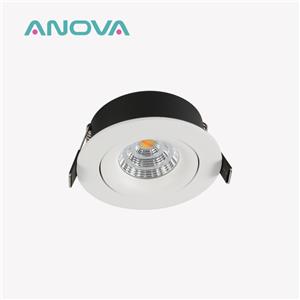
Specify a retail showcase from the display task and the cabinet section. A product category name alone is not enough. This guide is written for European importers and lighting specifiers working on jewelry and boutique display projects. It compares a mini spotlight for retail display, represented by FD17181, with a recessed downlight for retail showcases, represented by FSD1105. It also covers the surface-mounted version of the mini-light platform, FD17181-S.
The data in this guide comes from ANOVA lab measurements of production samples.
The decision starts with four questions. Can the cabinet accept a cut-out? Is the aim to draw attention to a small item or to cover a wider shelf? What mounting depth is available? What colour-rendering level does the merchandise require? The chosen configuration must still be checked against the cabinet drawing and the product documentation before release.
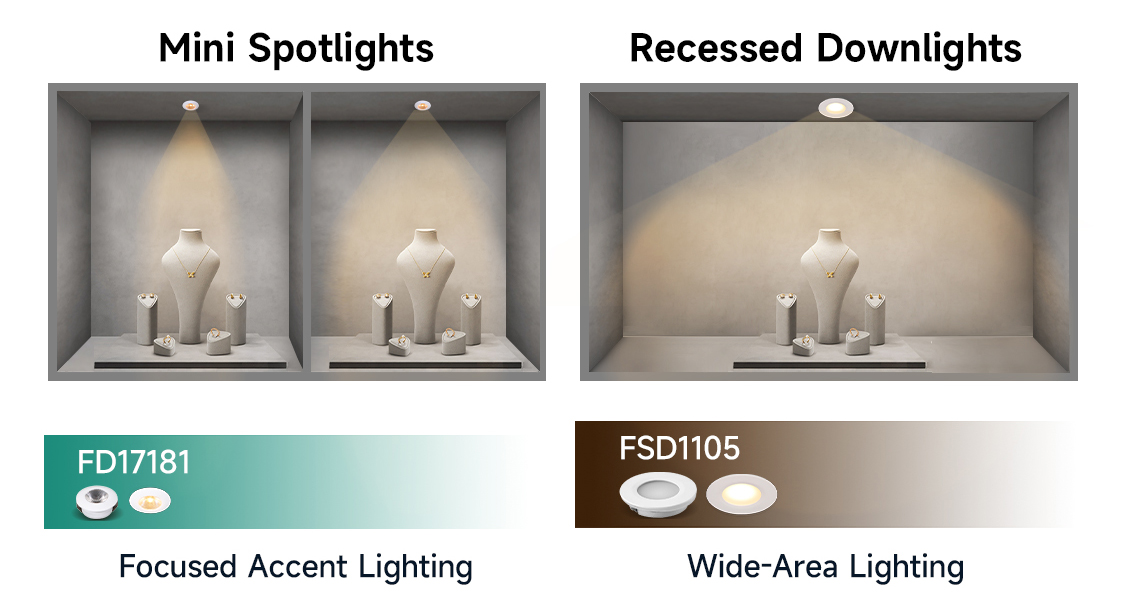
Mini spotlight vs recessed downlight for jewelry showcase lighting.
2. Mini Spotlight and Recessed Downlight Installation Differences
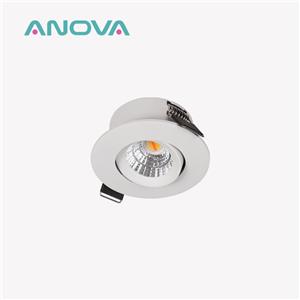
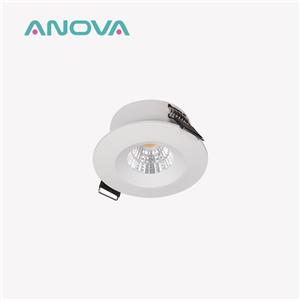
FD17181 is a compact LED cabinet light. In its recessed version, the cabinet requires a 29 mm cut-out. FD17181-S is the surface-mounted version and uses the same optical and electrical parameters as the recessed version. It is a useful route when the furniture drawing cannot accommodate a new opening. The mounting surface, cover, cable route and visible fixture position must all be accepted first.
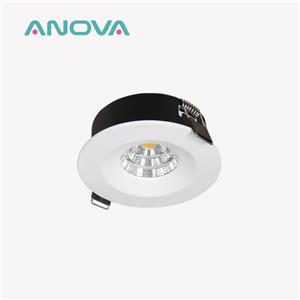
FSD1105 is a recessed LED cabinet downlight with a 59 mm cut-out. Its 13 mm fixture height helps where the cabinet top has limited depth. A shallow fitting still leaves the space for wiring, fixing parts and the selected electrical arrangement to be checked. FSD1105 has no surface-mounted alternative, so select it only when the cabinet construction supports recessed installation.
The practical distinction is simple. FD17181 offers a smaller aperture and can be specified as recessed or, through FD17181-S, as surface mounted. FSD1105 uses a larger aperture and creates a broader recessed lighting position. A cabinet section drawing should show the board thickness, cut-out location, space above the panel and intended cable route before either model is approved.
3. Measure the Cabinet Lighting Installation
The opening diameter is only one part of cabinet lighting installation. A drawing should separate the visible front diameter from the actual cut-out, then show the usable space behind the panel. For FD17181, the 29 mm opening supports a compact installation. For FSD1105, the 59 mm opening is larger and must be coordinated before the shelf or cabinet top is cut. Never scale an opening from a product photograph.
Record Fixed Conditions and Open Questions
Mark the material of the mounting panel, the location of glass, the space for the driver and the route to the nearest service point. If a dimension is not fixed, label it as an open question. Do not turn it into an assumption in the order. This matters most for repeated retail cabinets, where one unresolved detail is multiplied across a rollout.
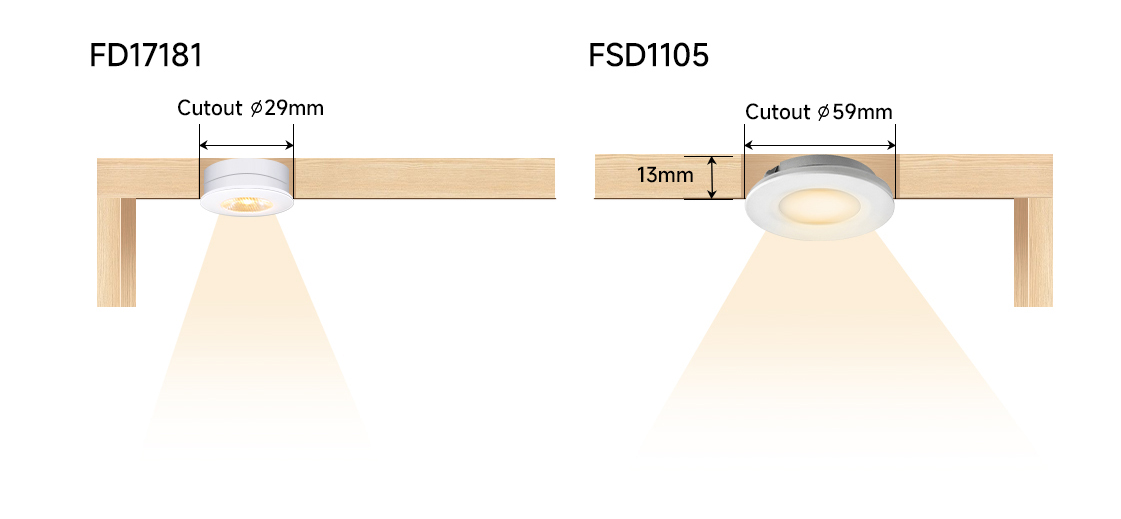
Check cut-out size and cabinet clearance before selecting recessed lighting.
4. Beam Angle and CRI for Jewelry Showcase Lighting
Choose Beam Angle from the Display Layout
Beam angle describes the spread of light. FD17181 is available with 24°, 40° and 60° beam angles. The narrower option suits a small item or a defined zone that needs stronger visual emphasis. The wider options reduce the contrast between a highlighted item and the surrounding display. FSD1105 has a 103° beam angle, which suits broader cabinet coverage and a softer accent.
Before selecting an optic, provide the distance from the luminaire to the merchandise, the width and depth of the shelf, the position of glass and the desired lighting emphasis. A narrow beam can leave an uneven result when the target is a full shelf. A wide beam can weaken the emphasis needed for an individual ring or watch. The display layout decides which compromise is appropriate.
Keep Beam Angle Separate from Aiming
Aiming is the direction of the fixture after installation. Beam angle is the spread of light from the optic. The models compared here are described as fixed, so the mounting position matters more. Moving the cut-out or the surface-mounted body changes the result. Where the display layout changes frequently, state that requirement before the product is selected. A narrow beam does not provide adjustment.
Check CRI and Colour Temperature Together
Specify colour rendering by the actual model. FD17181 is listed at Ra90 and FSD1105 at Ra80, and both examples are specified at 3000 K, per specification sheet. The colour rendering index is a useful check when the display contains colour-sensitive metals, stones or finishes. It does not by itself guarantee the final appearance of a complete showcase. Review representative merchandise under the proposed light before approving a customer-facing installation.
For a project requiring a higher colour-rendering threshold, record the requested Ra value and colour temperature in the purchase specification. Tie those choices to a named model and version, so the approved visual target stays attached to the product that will be supplied.
Review a Representative Display
A practical review includes the metals, stones, finishes and packaging that customers will actually see. Compare the display from the normal viewing angle, through the cabinet glass where applicable, and at the intended mounting distance. The review complements the CRI value. It checks whether the selected optic, colour temperature and physical position create an acceptable visual result for the project.
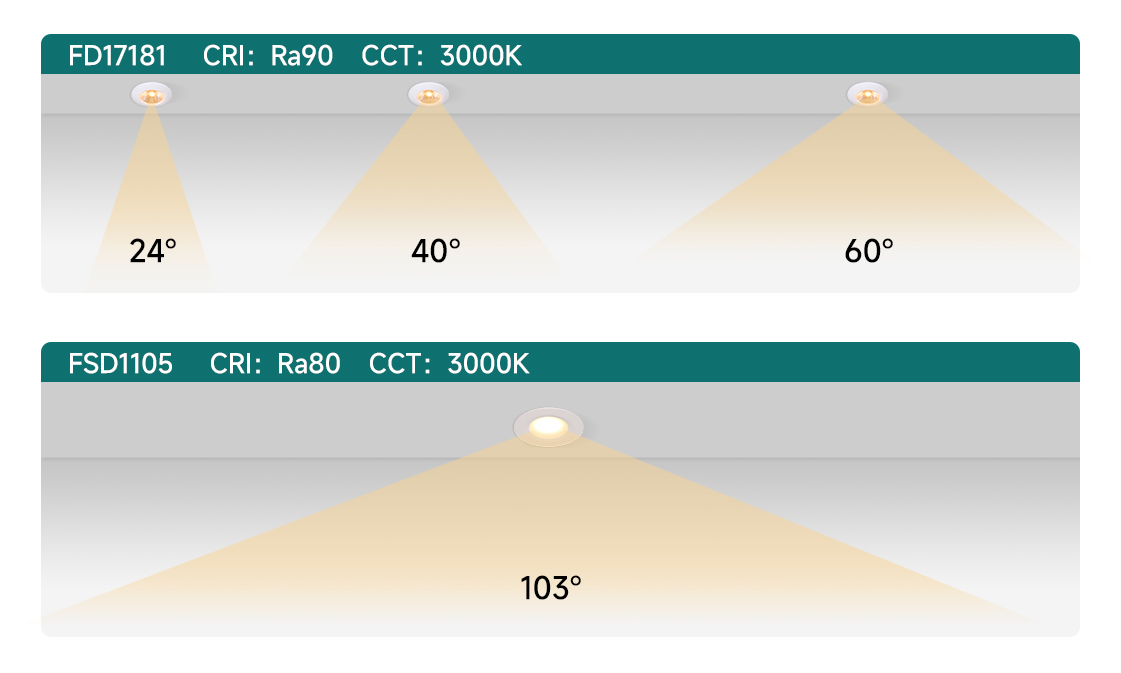
Beam angle and CRI comparison for retail showcase lighting.
5. FD17181 and FSD1105 Comparison Table
| Selection criterion | FD17181 / FD17181-S | FSD1105 |
| Installation | Recessed; FD17181-S surface-mounted version | Recessed |
| Cutout | 29 mm for recessed FD17181 | 59 mm |
| System power | 1 W | 3.3 W |
| Lumen output | 98 lm | 255 lm |
| CCT | 3000 K | 3000 K |
| Beam angle | 24° / 40° / 60° | 103° |
| CRI | Ra90 | Ra80 |
| Protection | IP44 | IP44 |
| Cabinet condition to check | Small opening or surface-mounting space; cable route | 59 mm opening; shallow fitting space; cable route |
Measured at ANOVA lab on production samples; values per specification sheet V3.2, 2026-08.
How to Use the Comparison
Use the table as a selection checklist. It does not rank the two models. If the cabinet is already complete or cannot be cut, evaluate FD17181-S and confirm its surface mounting position. If a 29 mm opening is feasible and a tighter beam is needed, the recessed FD17181 offers more beam-angle choice. If the display needs broader cabinet coverage and a 59 mm opening is available, FSD1105 is the more suitable of these two examples.
Document the lighting decision alongside the furniture drawing. Mark the cut-out, panel thickness, fixture position, light-to-merchandise distance, driver arrangement and cable route. This reduces late changes, particularly where multiple showcases must repeat the same installation detail. For a wider project configuration discussion, see our commercial downlight guide.
Prepare a Short Selection Brief
A useful enquiry does not need a complete engineering package. Supply a cabinet cross-section or marked photograph, the display dimensions, the type of merchandise, the preferred lighting effect and the target installation date. State whether the opening is already fixed, whether a surface-mounted body is acceptable and whether the cabinet uses a remote or local driver space. With these facts, a model recommendation can be reviewed against the actual installation instead of a generic retail-lighting description.
6. Compliance for EU Projects
EU projects need documents that match the exact model code. Before a purchase order is released, the EU importer should confirm in writing the CE declaration of conformity, the EN 60598 test reference and the RoHS declaration for each model and version, then check those files against specification sheet V3.2. Confirm the 230 V mains input and the driver ratings for the planned cabinet circuit at the same time. Keep the confirmed documents with the order file so the importer can present them at delivery and handover. This step protects both sides: the supplier provides the correct file set, and the buyer holds proof before the shipment leaves the factory.
7. Questions European Importers and Designers Ask
Should I choose a mini spotlight or a recessed downlight for a jewelry showcase?
Choose from the display task and cabinet construction. FD17181 provides 24°, 40° and 60° options and can also be specified as surface-mounted FD17181-S. FSD1105 is a recessed option with a 103° beam angle for broader coverage. Confirm the cabinet detail before selecting either model.
When should the cut-out size be confirmed?
Before the cabinet or shelf is manufactured. The recessed FD17181 needs a 29 mm cut-out, and FSD1105 needs a 59 mm cut-out. Confirm the selected version, panel construction and cable route together.
Does a higher CRI automatically produce the strongest jewelry display?
No. FD17181 is specified at Ra90 and FSD1105 at Ra80. The final appearance also depends on colour temperature, optic, fixture position, surrounding materials and the actual merchandise. Review representative items before approval.
Can an existing showcase be updated without a new cut-out?
FD17181-S is the surface-mounted version of FD17181 and uses the same optical and electrical parameters. Confirm the mounting position, cover, wiring route and visibility of the fixture for the finished cabinet.
Which compliance documents should an EU importer request before ordering?
Request the CE declaration of conformity, the EN 60598 test reference and the RoHS declaration for the exact model code, and check them against the specification sheet. Confirm the 230 V supply arrangement and driver ratings in the same step.
What should a mini spotlight for retail display enquiry include?
Include a cabinet cross-section, display dimensions, the type of merchandise, the light-to-merchandise distance, the preferred lighting effect and whether a fixed cut-out or a surface-mounted body is required.
8. Request a Model Shortlist
Send the cabinet section, cut-out constraint, display dimensions, mounting distance and preferred lighting result to contact our sales team. A concise brief lets the technical team confirm whether FD17181, FD17181-S, FSD1105 or another cabinet-light configuration fits the installation. If you are preparing a broader custom request, use our project brief checklist to organise the installation, optical and electrical information.
Related product information: Mini Spotlight and LED Cabinet Downlight.