
Lighting Procurement Timeline Q4 Backward Planning Guide
Lighting Procurement Timeline Q4 Backward Planning Guide
Picture two distributors buying the same downlight at the same price. One receives stock in the week its customers expected it; the other is still waiting on a revised sailing while the selling season moves on. A missed delivery window costs more than a price gap. It costs shelf space, project goodwill, and the kind of trust that never appears on an invoice.
That is why experienced buyers build a lighting procurement timeline backward from the delivery week, not forward from the day they send a purchase order. This guide uses relative weeks only. It is not a lead-time promise, but a planning skeleton to confirm with your factory for every order.

Backward lighting procurement planning begins with the required delivery week, then works through samples, production and freight.
1. Why the calendar runs backward
Order-anchored planning asks, "When will my order arrive?" and treats the answer as a surprise. Delivery-anchored planning asks, "When must stock be in my warehouse?" It treats that date as fixed, then walks every milestone backward: samples, production slot, inspection, booking, sailing, customs and delivery.
This method is designed for procurement teams at lighting wholesalers, importers and distributors placing quarterly orders with overseas manufacturers. It matters most when a quarter includes new SKUs, a first ODM programme, or a move into a new product family such as 24V or 48V magnetic track lighting or DALI-2-controlled lines.
If you are still evaluating factories, use this China LED ODM manufacturer checklist before discussing a delivery schedule. If the sourcing model itself is still undecided, compare ODM, OEM and private-label manufacturing before setting the brief.
Lighting lead-time planning fails when it is treated as one number. It works when it is treated as a chain of owned milestones, each with a deadline derived from Week 0.
2. The backward-planning skeleton
Set Week 0 as the week goods must be delivered to your warehouse or project site. Every other milestone is a negative number counted back from it. The table below is an illustrative planning skeleton, not a lead-time promise. Confirm each window with the factory for the specific order, because project size, product family and season can all change the schedule.
| Relative week | Milestone | What good looks like | Who owns it |
| Week −12 | Kickoff: brief, product family and quotation agreed | A written brief covers optical, electrical and mechanical targets; the ODM scope is agreed | Buyer + sales engineer |
| Week −10 | First samples dispatched | Samples are built to the brief, with test data accompanying each unit | Engineering team |
| Week −8 | Sample review closed; golden sample signed | Consolidated review notes, one decision memo and a signed golden sample are retained as the reference | Buyer |
| Week −6 | Purchase order placed; production slot booked | The PO references the golden sample and batch-traceability requirements; the factory slot is confirmed in writing | Buyer + factory planning |
| Week −4 | Production underway; mid-production check | Materials are verified against the approved specification; batch records are opened and traceable | Factory production team |
| Week −2 | Pre-shipment review passed; freight and documents in motion | Inspection scope is agreed; destination-market documents are requested; freight arrangements are confirmed | Buyer + forwarder |
| Week 0 | Delivery window | Goods arrive within the target week; any discrepancy is logged against batch records | Buyer |
Week 0 is defined as goods received at the buyer's nominated location. Transit, customs and last-mile windows must be backward-planned separately for each route and season; where the route is longer, shift upstream milestones accordingly.
Treat each row as a question, not a date. If a milestone slips, agree the remedy in the same week and reset the deadline from Week 0. Avoid vague commitments such as "as soon as possible."
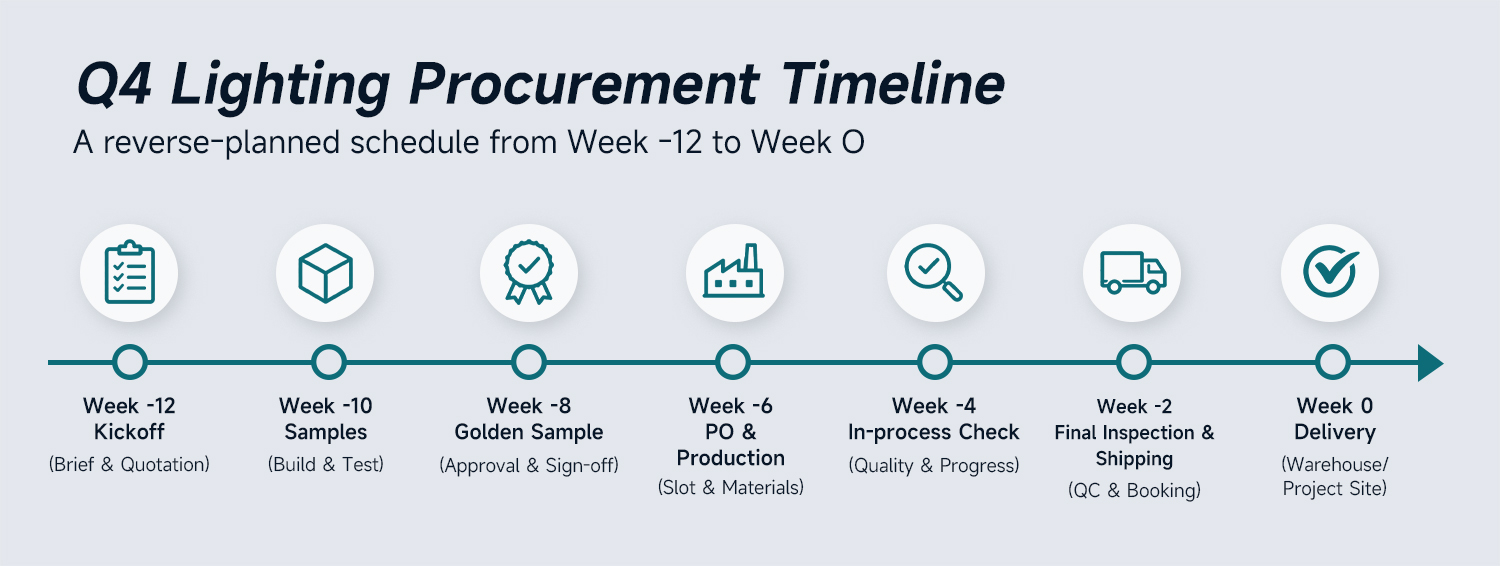
A Q4 lighting order schedule maps each procurement milestone backward from the target delivery week.
3. Sample stage: from first sample to golden sample
What to review on a sample
Review three layers and keep them separate in your notes.
Optically, check colour temperature, tint consistency and colour rendering against the approved specification. A commercial LED downlight specification checklist can help turn those expectations into clear brief requirements.
Mechanically, check fit, finish, gasket seating and rating features for the intended installation environment. Electrically, confirm driver behaviour, including dimming response, wireless-control pairing where applicable and flicker performance, on a sample from the intended product platform rather than a substitute.
Golden sample discipline
A golden sample is the signed physical reference that both buyer and factory agree mass production must match. Under ANOVA golden-sample control, the approved unit is documented, labelled and archived so pre-shipment comparison is routine rather than an argument.
When the buyer's golden sample and the factory's retained copy represent the same approved configuration, later discussions about optics, finish and electrical behaviour can be resolved against a shared physical reference.
Keeping sample rounds to a minimum
Sample rounds drag when feedback arrives as scattered opinions. Close every round with a short decision memo stating what was approved, what must change, who signs off and the deadline for the next round.
One memo per round keeps engineering focused and prevents the sample stage from quietly consuming buffer weeks.
4. Production and pre-shipment checkpoints
Production slot booking
Book the production slot when the PO is placed, not when samples close. State the product family clearly because different platforms load production differently. A 24V or 48V magnetic-track programme, a DALI-2 or Casambi-equipped line, a high-efficacy platform or a recycled-material series can each follow a different material and assembly path.
For applications involving track, drivers and fixtures, reviewing 24V magnetic track lighting options before confirming the order structure can help identify control, optical and installation dependencies early. For broader configuration planning, OEM/ODM lighting project development provides a useful framework for mapping requirements to an approved production configuration.
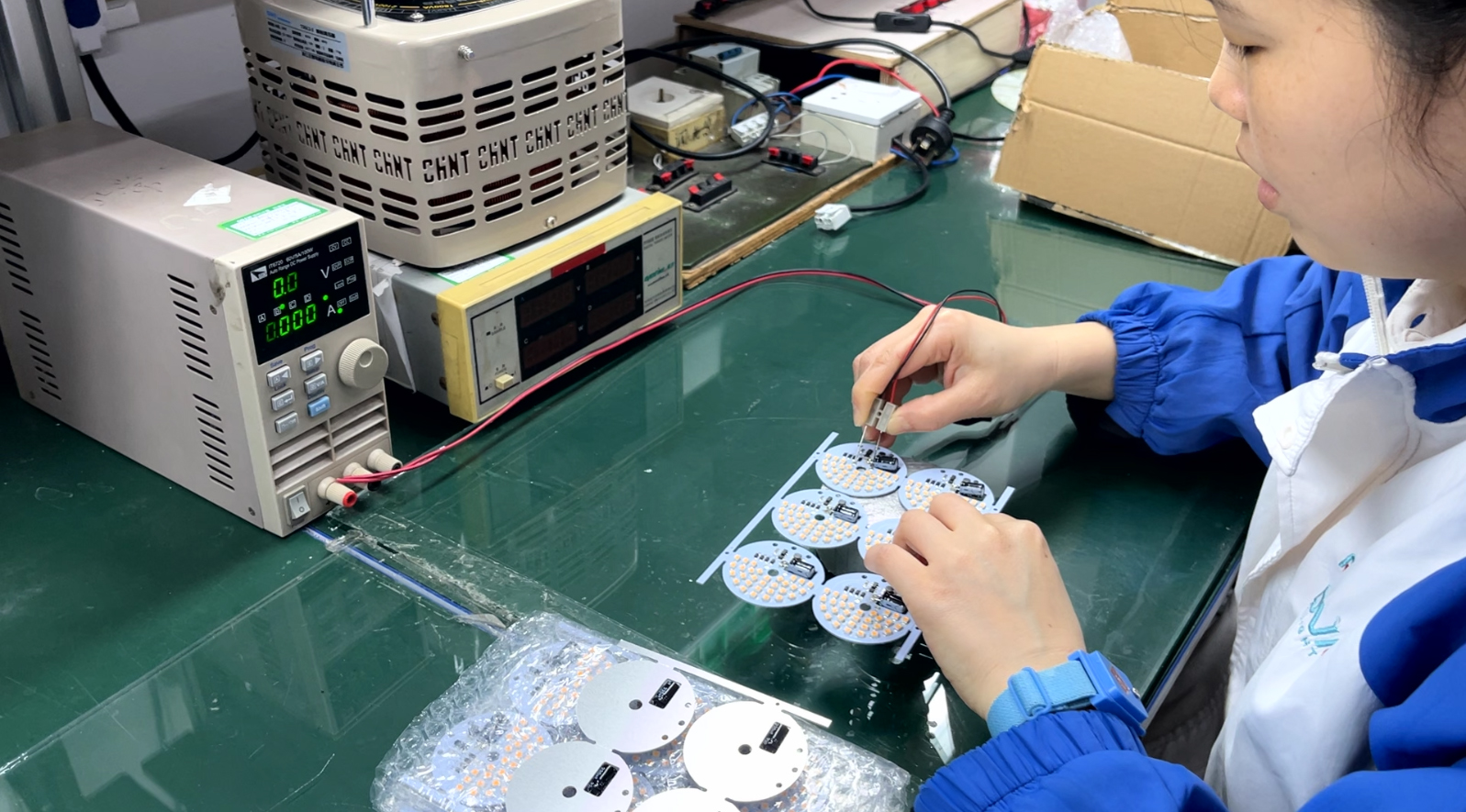
In-process LED module inspection helps verify assembly quality before final inspection and shipment.
Pre-shipment review: what to verify before goods leave
The pre-shipment review is the final low-cost checkpoint before goods leave the factory. Verify that production matches the golden sample, batch-traceability records are complete enough to support an after-sales claim, and the documentation set for the destination market has been requested and is in progress. Destination-market documentation should be confirmed at the kickoff stage and only finally re-checked before shipment.
Depending on the target market, applicable documentation and approval requirements may include CE and UKCA compliance documentation, as well as SASO, ECAS or ESMA requirements, where applicable.
5. Logistics windows that move
Sea freight is often the least controllable link in the chain and the most seasonal. Rates move with demand, carriers adjust sailings, and the weeks before major holidays can bring congestion at ports and on the landside.
The practical response is not to pretend that logistics can be fixed months in advance. It is to separate the decisions that should be made early from the decisions that should remain flexible.

Freight booking remains a moving part of the lighting procurement timeline during peak shipping periods.
What buyers should fix early versus confirm late
Fix early: the delivery window, the forwarder relationship and the document checklist.
Confirm later: the exact sailing, selected once the pre-shipment review has passed and the goods are ready to move.
The principle is simple. Make early decisions for items that take weeks to change. Make later decisions for items that take days to change.
6. A quarterly rhythm that repeats
A Q4 lighting order schedule works most effectively when Q1 orders begin in Q4. Use this quarter's skeleton as the next quarter's template. While current orders are in production, open the brief for the next cycle, confirm product families and communicate new target delivery windows.
Preparing an ODM project brief early is what turns a rushed Q4 into a controlled one. Calendar discipline is mostly habit: one owner per milestone, one shared backward plan for each order and one fixed internal review day each week.
7. Common failure points
● Sample rounds dragging: Scattered feedback and no decision memo can turn weeks into months.
● Unclear approver: If no one owns sign-off, the golden sample stays unsigned and the PO slips.
● Booking too late: Waiting for finished goods before discussing freight hands the schedule to the busiest season.
● Documents started late: Compliance paperwork requested after production closes can become the customs critical path.
8. Send your schedule
Backward planning starts with three inputs: your target delivery window, product family and destination market. Send these details to sales@anovalighting.com. You will typically receive a response within three business days with a proposed milestone plan built around one-window ODM, covering structural, optical, thermal and circuit engineering under one roof.
Final production scheduling is always confirmed case by case.
While preparing your brief, explore configurable LED modules and light engines to shortlist the platforms that may support your next quarter's programme.
FAQs
How early should I order lighting for Q1 delivery?
Work backward from the required delivery week and confirm every window with the factory for the specific order. As a planning habit, open the brief and sample stage in Q4 for Q1 delivery, because samples, production slots and year-end freight all compete for the same weeks. Project size, product family and season change the numbers. Treat a generic lead time as a starting question, not an answer.
What is a golden sample in lighting manufacturing?
A golden sample is the signed physical unit that both buyer and factory accept as the reference for mass production. It captures optical output, mechanical finish and electrical behaviour in one object, so pre-shipment comparison is factual rather than negotiated. ANOVA archives the approved reference under golden-sample control to help prevent drift between sample approval and inspection.
How many sample rounds are normal before mass production?
There is no fixed number because sample rounds exist to close specific gaps in optics, mechanics or electronics. What should remain fixed is the discipline: one consolidated feedback memo per round, a named approver and a deadline for the next iteration. Most delays come from unfocused rounds, not from the sample work itself.
When should I book sea freight for year-end orders?
Agree the forwarder relationship and document checklist early. Select the specific sailing after the pre-shipment review has passed. Year-end congestion and rate volatility can make last-minute space harder and more expensive, so the booking conversation should start while production is underway, not after it closes.
How do I confirm the right lighting procurement timeline with my factory?
Send the target delivery window, product family and destination market, then ask the factory to propose milestones backward from Week 0. Review each window against project size, product family and season. Confirm the production slot in writing with the purchase order, then reconfirm logistics windows as the pre-shipment review approaches.